 Owner@dscareers.site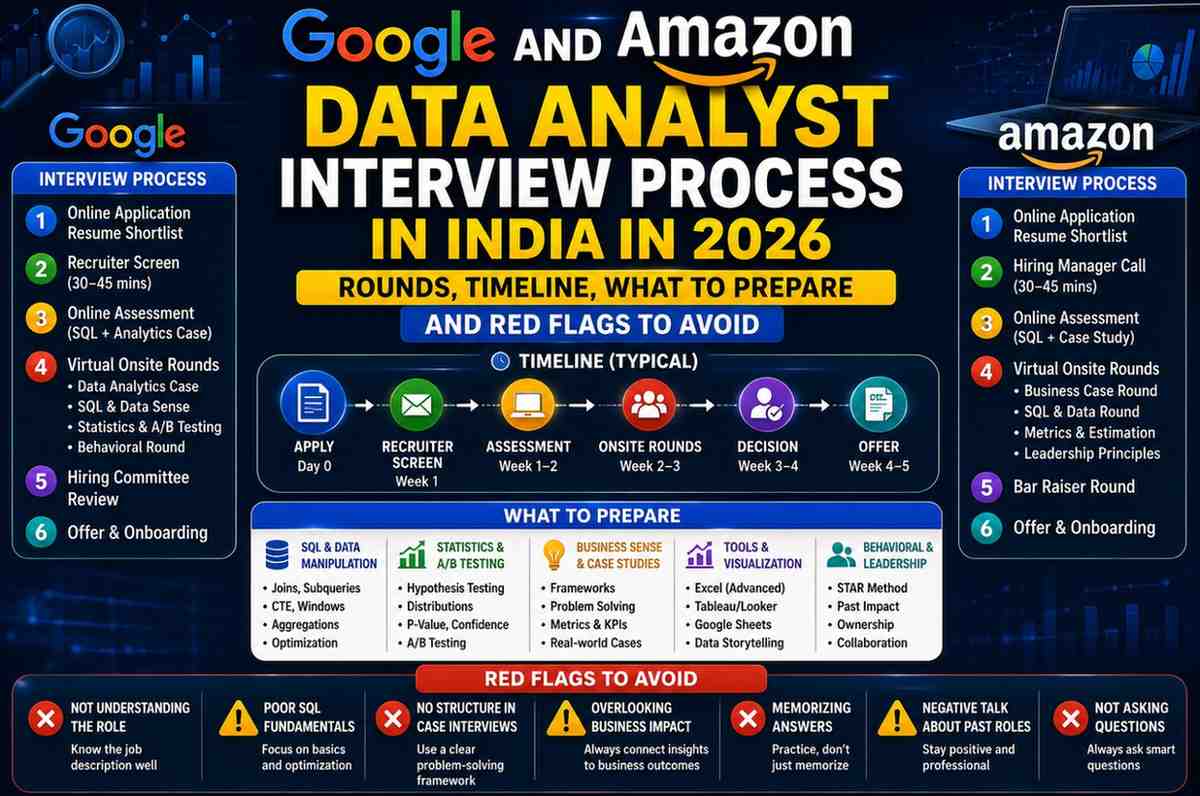
Landing a data analyst role at Google or Amazon in India is one of the most sought-after career goals in the Indian tech industry—and one of the most competitive. The Google and Amazon data analyst interview process in India in 2026 is structured, rigorous, and deliberately different from what most Indian companies do. Candidates who walk in without understanding the specific format almost always underperform — not because they lack skills, but because they are preparing for the wrong things.
This complete guide to the Google and Amazon data analyst interview process in India 2026 covers everything you need to know: exact interview rounds, typical timelines, what to prepare for each stage, real examples of questions asked, and the specific red flags that get otherwise qualified candidates rejected.
Whether you are applying fresh or have been through a rejection and want to understand what went wrong—this guide maps out the Google and Amazon data analyst interview process in India 2026 in more detail than any generic interview guide will give you.
Why These Two Companies Are Different
Before diving into the specifics, it is important to understand why the Google and Amazon data analyst interview process in India 2026 differs fundamentally from interviews at Indian IT services firms or even most Indian product companies.
Google uses a structured, standardized interview process designed to eliminate interviewer bias. Every stage is carefully designed, interviewers are trained to follow specific rubrics, and all feedback is aggregated by a hiring committee that makes the final decision—not the hiring manager alone.
Amazon interviews are anchored in the company’s 16 leadership principles. Every interview question—technical or behavioral—is evaluated against these principles. Understanding and preparing for them is not optional — it is the entire framework of Amazon’s hiring process.
Both companies hire primarily for potential and thinking quality — not just current skill level. This is the most important principle behind the entire Google and Amazon data analyst interview process in India in 2026.
Part 1: Amazon Data Analyst Interview Process India 2026
The Amazon India Interview Timeline
The typical timeline for the Google and Amazon data analyst interview process in India for 2026 at Amazon runs approximately 4–8 weeks from application to offer:
Week 1: Application + recruiter screening call (30 minutes) Week 2: Online assessment — SQL and analytics test (60–90 minutes, timed) Week 3–4: Virtual interview loop (4–5 rounds, usually on one or two days) Week 5–6: Hiring committee review and background check Weeks 6–8: Offer extended and negotiation
Amazon Interview Rounds for Data Analyst India
Round 1 — Recruiter Screening (30 min): A call with the Amazon India recruiter. They assess your background, motivation, and basic fit. Be ready to answer “Why Amazon?” with a specific, non-generic answer that references actual Amazon products or data initiatives you find interesting.
Round 2—Online Assessment (60–90 min): This is typically a timed test on HackerRank or an Amazon-specific platform covering:
- SQL queries (JOINs, aggregations, window functions, subqueries)
- Basic statistics and probability
- Data interpretation questions
- Sometimes Python/pandas problems
The SQL questions in this stage are medium- to hard-difficulty—expect complex multi-table JOINs, GROUP BY with HAVING, and window functions like RANK(), ROW_NUMBER(), and LAG(). This is one of the most important preparation areas in the Google and Amazon data analyst interview process in India 2026.
Round 3 — Bar Raiser Round (60 min): Amazon’s unique interview element. The Bar Raiser is a specially trained senior Amazon employee — not from the hiring team — who assesses whether you raise the average bar of Amazon’s workforce. They ask a mix of technical and behavioral questions and evaluate against Amazon’s Leadership Principles very rigorously.
Rounds 4–5 — Technical + Behavioral Loops (60 min each): Each interviewer covers 1–2 Leadership Principles plus technical depth in SQL, analytics, statistics, or business case questions. They take notes and rate you against a specific rubric.
Amazon Leadership Principles — What Data Analysts Are Tested On
The most unique element of the Google and Amazon data analyst interview process in India 2026 at Amazon is the Leadership Principles framework. The 16 principles include:
- Customer Obsession — start with the customer and work backward
- Dive Deep — stay connected to details; data and anecdotes
- Bias for Action — speed matters; take calculated risks
- Deliver Results — focus on key inputs; deliver with the right quality and in a timely fashion
- Are Right, A Lot—strong judgment; seek diverse perspectives
- Invent and Simplify—find simpler solutions; embrace external ideas
For data analyst roles specifically, Dive Deep and Are Right, A Lot are most heavily tested—because analysts are expected to own data quality and push back on incorrect assumptions with evidence.
Preparation strategy: Write out 2 STAR stories for every leadership principle. That is 32 prepared stories total—most interviewers test 2–3 principles, so having thorough coverage ensures you are never caught unprepared in the Google and Amazon data analyst interview process in India in 2026.
Amazon SQL Questions — Real Examples
The SQL round at Amazon India in 2026 typically includes questions like the following:
Question type 1—Cohort analysis: “Given a table of user logins with user_id and login_date, write a query to find users who logged in for 7 consecutive days.”
Question type 2—Window functions: “Given a sales table, write a query that shows for each salesperson their sales in the current month and their rank among all salespeople in the same region.”
Question type 3—Data cleaning: “A transactions table has duplicate rows where the same transaction_id appears multiple times. Write a query to return only the most recent record per transaction ID.”
Question type 4 — Business metric: “Write a query to calculate the 30-day retention rate of users acquired in January 2026.”
Preparing for all four question types is essential for the technical portion of the Google and Amazon data analyst interview process India 2026 at Amazon.
Part 2: Google Data Analyst Interview Process India 2026
The Google India Interview Timeline
Google’s process is slightly longer than Amazon’s and more committee-driven:
Week 1: Application via Google Careers or referral Week 2: Recruiter screening call (30–45 min) Week 3: Phone/video technical screen (45–60 min) Week 4–5: Onsite (virtual) interview loop — 4–5 rounds Week 6–8: Hiring committee review Week 8–12: Offer (Google’s committee process takes longer than most companies)
The Google and Amazon data analyst interview process in India for 2026 at Google is notable for how long the committee review takes—candidates sometimes wait 6–8 weeks after their final round before receiving a decision. This is normal. Do not interpret silence as rejection.
Google Interview Rounds for Data Analyst India
Round 1 — Recruiter Screen (30–45 min): Background, motivation, and a few high-level analytical questions. Be ready to discuss a specific analytics project in detail — what the business question was, how you approached it, and what the outcome was.
Round 2 — Technical Phone Screen (45–60 min): SQL and analytical thinking. Google’s SQL questions at this stage focus on correctness and efficiency. You may be asked to write queries on a shared document or coding platform.
Rounds 3–6 — Virtual Onsite Loop:
Google’s onsite loop for data analyst roles in India typically covers 4 areas:
Analytics Case Study (×2 rounds): Given a business scenario—typically related to Google’s products (Search, YouTube, Maps, or Ads)—you are asked to define metrics, diagnose problems, or design measurement frameworks.
Example: “YouTube’s watch time in India dropped 15% week over week. Walk me through how you would investigate this.”
SQL / Coding (×1 round): Medium-to-hard SQL with some Python or statistical analysis. Google expects analysts to write clean, efficient queries — not just correct ones.
Behavioral / Leadership (×1 round): Structured STAR questions around collaboration, dealing with ambiguity, and influencing without authority. Google calls this the “Googleyness” assessment—evaluating cultural fit, intellectual humility, and collaborative instinct.
Google’s Analytics Case Study Framework
The analytics case study is the most distinctive element of the Google and Amazon data analyst interview process in India 2026 at Google and the area where most candidates are underprepared.
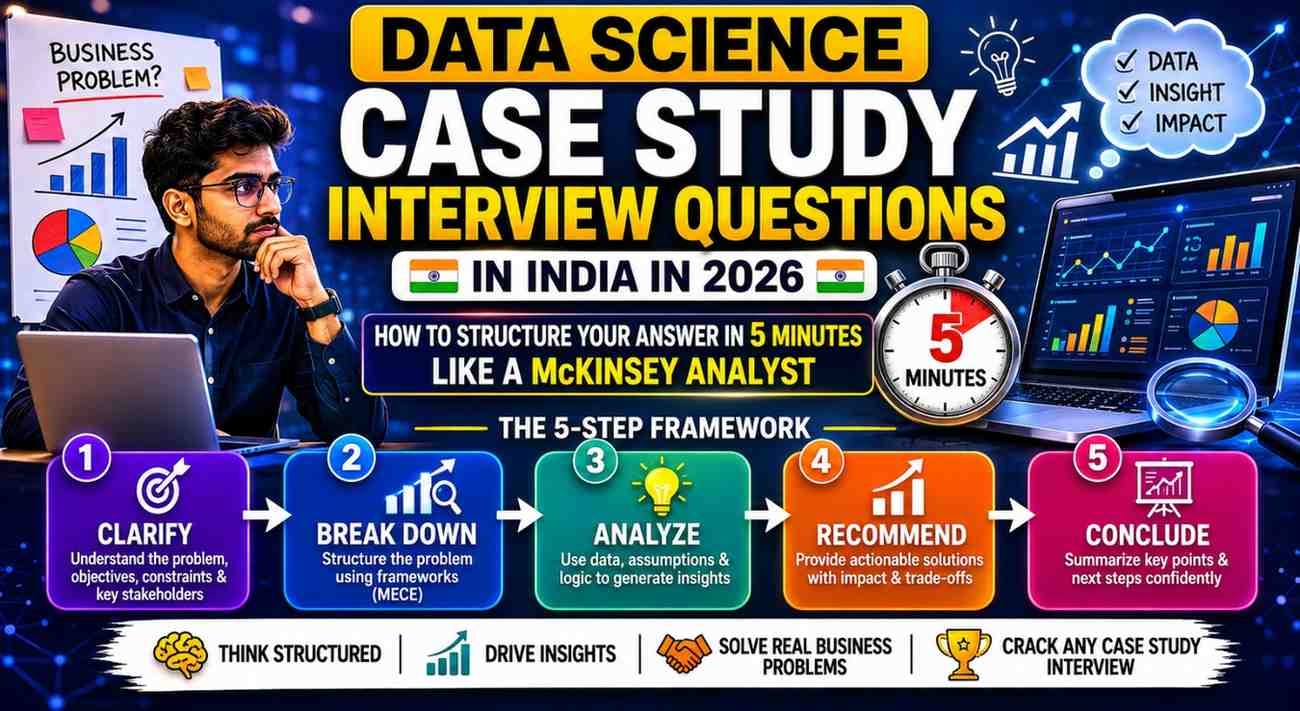
A strong case study answer follows this structure:
1. Clarify the problem (2 minutes): “Before I dive in, can I ask—when you say watch time dropped, is this all content types or specific to one category? Are we looking at all of India or a specific region?”
2. Form hypotheses (3 minutes): “I would group my hypotheses into three buckets—internal product changes, external/competitive factors, and data/measurement issues.”
3. Design the investigation (5 minutes): “I would start by checking whether this is a data pipeline issue—if not, I would segment by platform (mobile vs. web), geography, and content type to narrow down where the drop is concentrated.”
4. Identify key metrics (3 minutes): “The primary metric is watch time, but I would also look at sessions, session duration, content completion rate, and new vs. returning user breakdown.”
5. Recommend next steps (2 minutes): “Based on the segmentation, I would prioritize either a product fix, a content strategy change, or an investigation of competitive apps gaining share.”
Practicing this framework repeatedly with Google product examples is the most important preparation for the Google and Amazon data analyst interview process in India 2026 at Google.
Google SQL Questions — Real Examples
Question type 1 — Complex aggregation: “Given a table of ad impressions and a table of clicks, write a query to calculate the click-through rate by ad campaign for the last 30 days, only showing campaigns with at least 1,000 impressions.”
Question type 2 — Ranking: “Write a query to find the top 3 most-watched videos per country in the last 7 days.”
Question type 3—Funnel analysis: “Given a user events table with event_name and timestamp, write a query to calculate how many users completed all three steps of the onboarding funnel in sequence within 24 hours.”
Key Differences Between Google and Amazon Interviews
| Dimension | Amazon India | Google India |
|---|---|---|
| Framework | Leadership Principles (16) | Googleyness + analytical case study |
| SQL difficulty | Hard (window functions, multi-table) | Hard (efficiency + correctness) |
| Behavioural depth | Very deep—every question LP-anchored | Moderate — structured but less rigid |
| Case study | Analytics metrics + business diagnosis | Product analytics + metric frameworks |
| Timeline | 4–6 weeks | 6–10 weeks |
| Bar Raiser | Unique to Amazon | Not applicable |
| Hiring decision | Hiring committee | Hiring committee (longer process) |
| Referral impact | High | High |
Understanding both sides of this comparison is central to preparing effectively for the Google and Amazon data analyst interview process in India 2026.
Red Flags That Get Candidates Rejected at Google and Amazon India
These are the specific behaviors that consistently result in rejections—even for technically strong candidates—in the Google and Amazon data analyst interview process in India in 2026:
Red Flag 1 — Jumping to solutions without clarifying: Both companies heavily penalize candidates who start solving a problem without asking clarifying questions. Interviewers interpret this as poor analytical discipline.
Red Flag 2 — Vague STAR answers (“We did this as a team”): Amazon interviewers specifically probe for individual contribution. “We” answers signal either that you are not confident in your own contribution or that you are inflating a team achievement.
Red Flag 3 — Not knowing your own resume: Being unable to discuss the methodology, results, or business impact of projects listed on your resume is an immediate red flag at both companies.
Red Flag 4—Showing discomfort with ambiguity: Data analyst roles at Google and Amazon India involve significant ambiguity—undefined problems, imperfect data, and unclear business questions. Candidates who ask for very precise specifications before starting analysis are flagged as low independence.
Red Flag 5 — Weak “Why this company?” Answers: “I have always wanted to work at Google/Amazon” is not an answer. Interviewers want to hear about specific products, data challenges, or business problems that genuinely interest you. Generic answers signal low research and low commitment in the Google and Amazon data analyst interview process in India 2026.
📍 Image 1 Placement: Place a side-by-side comparison visual here showing the Amazon vs. Google interview process stages in parallel columns. ALT Text: Google and Amazon data analyst interview process India 2026—side-by-side comparison of interview rounds at both companies
📍 Image 2 Placement: Place an Amazon Leadership Principles reference card showing all 16 principles in a clean grid format. ALT Text: Google and Amazon data analyst interview process India 2026—Amazon Leadership Principles reference card for interview preparation
30-Day Preparation Plan for Google/Amazon Data Analyst India
Week 1 — SQL Mastery: Practice 3 SQL problems daily on LeetCode or StrataScratch (medium and hard). Focus on window functions, CTEs, and multi-table JOINs. These are the most tested areas in the Google and Amazon data analyst interview process in India 2026.
Week 2 — Statistics and Analytics Fundamentals: Review A/B testing concepts, confidence intervals, p-values, and statistical significance. Understand metrics design—guardrail metrics, success metrics, and counter metrics. Practice stating hypotheses clearly.
Week 3 — Analytics Case Studies: Practice 2 analytics case studies per day using Google product scenarios. Record yourself on video and review your answer structure. Focus on clarifying questions, hypothesis formation, and metric selection.
Week 4 — Behavioral Stories: Write and practice STAR stories for all 16 Amazon Leadership Principles. Practice 3 behavioral questions daily with a peer or mentor. Polish your “Tell me about yourself” and “Why Amazon/Google?” answers specifically.
FAQ: Google and Amazon Data Analyst Interview Process India 2026
Q1. Is it harder to get into Google or Amazon as a data analyst in India? Both are extremely competitive — acceptance rates for data analyst roles are under 1% of applicants. Google’s process is longer and more committee-driven. Amazon’s is more structured around leadership principles. For most candidates, Amazon’s predictable LP framework makes preparation more systematic in the Google and Amazon data analyst interview process in India in 2026.
Q2. Does a referral from a current employee significantly help at Google and Amazon India? Yes — significantly. Referred candidates at both companies skip initial resume screening and go directly to the recruiter screen. Internal referrals also carry weight in the hiring committee discussion. Building your network on LinkedIn and attending Google and Amazon India tech events to find internal connections is one of the most practical strategies for the Google and Amazon data analyst interview process India 2026.
Q3. How many LeetCode SQL problems should I solve before applying? Solve at least 50–75 Medium and Hard SQL problems on LeetCode, StrataScratch, or DataLemur. Focus on window functions (RANK, ROW_NUMBER, LAG, LEAD), GROUP BY with complex HAVING clauses, and multi-CTE queries. These are consistently the hardest SQL types in the Google and Amazon data analyst interview process in India in 2026.
Q4. What is the salary range for data analysts at Google and Amazon India in 2026? Based on current market data, senior data analyst roles at Amazon India range from ₹25–45 LPA (CTC including ESOPs and bonuses). Google India data analyst roles range from ₹28–55 LPA at L4/L5 levels. Both are significantly above the Indian market average, which drives the intense competition for these roles in the Google and Amazon data analyst interview process in India in 2026.
Q5. Can freshers apply for data analyst roles at Google and Amazon India? Amazon India hires freshers under the “SDE New Grad” and analytics associate programs—typically campus placements from IITs, IIMs, and top NITs. Direct applications from non-campus freshers are very difficult but not impossible with a strong portfolio. Google India rarely hires freshers through direct application—campus or referral paths are much more effective entry points to the Google and Amazon data analyst interview process in India 2026.
Conclusion
The Google and Amazon data analyst interview process in India 2026 is among the most rigorous in the industry—but it is also among the most learnable. Both companies follow structured, predictable formats. Both test the same core areas: SQL, analytical thinking, metrics design, and behavioral competencies.
The candidates who succeed follow a disciplined 4-week preparation plan, practice real case studies out loud, prepare comprehensive STAR stories anchored to Amazon’s Leadership Principles, and demonstrate genuine business curiosity rather than just technical proficiency.
Start today with the highest-impact action: Solve five SQL window function problems on LeetCode or DataLemur right now. That single hour of practice will directly prepare you for the most common technical filter in the entire Google and Amazon data analyst interview process in India in 2026.
The offer is achievable. The preparation is finite. The difference between candidates who get in and those who do not is almost always preparation quality — not raw talent.