 Owner@dscareers.site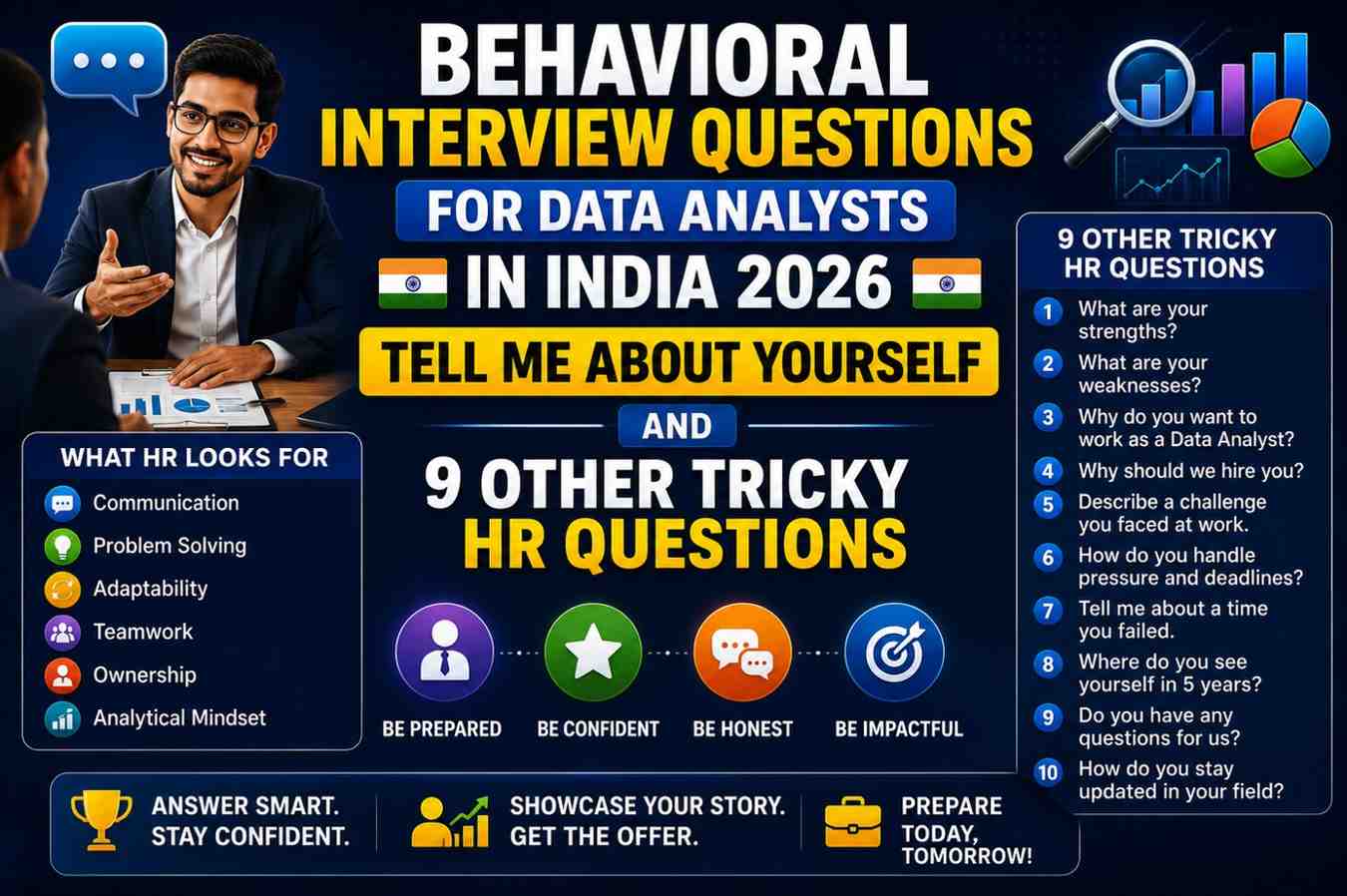
Most data analyst candidates in India spend 95% of their interview preparation on SQL, Python, and dashboards — and almost nothing on the HR round. That is a serious mistake. Behavioral interview questions for data analysts in India in 2026 are increasingly used as elimination rounds, especially at top Indian and multinational companies. A weak HR round can eliminate even technically brilliant candidates.
This guide covers the 10 most important behavioral interview questions for data analysts in India in 2026—with full model answers, the STAR framework, and specific tips for the Indian workplace context. Whether you are applying at TCS, Wipro, Flipkart, Amazon India, or a startup, these answers will help you walk into your HR round with confidence.
Why Behavioural Questions Matter More Than Ever in 2026
Companies in India have realized that technical skills can be trained—but communication, critical thinking, resilience, and collaboration are harder to develop. This is why behavioral interview questions for data analysts in India in 2026 carry more weight than ever in the screening process.
Specifically, interviewers use these questions to assess the following:
- How you handle ambiguity (common in data analyst roles)
- Whether you can communicate complex data insights to non-technical stakeholders
- How you respond to conflict, failure, and feedback
- Whether your values and work style fit the team culture
Preparing your behavioral interview questions for Data Analyst India 2026 answers properly is not about memorizing scripts—it is about having your best real stories ready and structured clearly.
The STAR Method: Your Answer Framework
Before the questions, understand the framework behind every great answer to behavioral interview questions for data analysts in India in 2026:
S — Situation: Set the context. Where were you? What was the project or challenge?
T — Task: What was your specific responsibility or goal?
A — Action: What did YOU do? (Use “I,” not “we.”)
R — Result: What was the measurable outcome? Quantify wherever possible.
Every strong answer to behavioral interview questions for data analysts in India in 2026 follows this structure—it keeps your answer focused, credible, and memorable.
📍 Image 1 Placement: Place a clean infographic here showing the STAR method — four boxes (Situation, Task, Action, Result) with a brief description of each. ALT Text: Behavioural interview questions for data analysts in India 2026—STAR method framework diagram for structuring answers
The 10 Most Important Behavioural Interview Questions for Data Analysts in India 2026
Q1. “Tell me about yourself.”
This is always the opening question and one of the most important behavioral interview questions for data analysts in India in 2026. Most candidates waste it by reciting their CVs. Do not do that.
Model Answer Framework (2 minutes max):
Open with your current role or most recent position → highlight 1–2 key technical skills with real impact → briefly mention your background/education → close with why you are excited about this role.
Model Answer: “I am a data analyst with three years of experience at [Company], where I primarily work with SQL, Python, and Power BI to support the sales and marketing teams. In my most recent project, I built an automated customer churn prediction model that helped the retention team reduce churn by 18% over six months.
Before that, I completed my B.Tech. in Computer Science from [College] and interned at [Company], where I got my first exposure to real-world data pipelines. I am now looking to move into a role where I can work with larger, more complex datasets and contribute to product-level analytics, which is exactly what this role offers. That is what excites me most about this opportunity.”
Key tips for Indian candidates: Mention specific tools and quantified achievements early. Interviewers at Indian companies and MNCs value conciseness and technical specificity in this opening answer to behavioral interview questions for data analysts in India in 2026.
Q2. “Tell me about a time you worked with a difficult stakeholder.”
This is one of the most revealing behavioral interview questions for data analysts in India in 2026—it tests your communication and conflict management skills.
Model Answer: “Situation: In my previous role, I was assigned to build a weekly sales dashboard for the VP of Sales. He had very specific requirements but communicated them in scattered Slack messages and changed his mind frequently.
Task: My goal was to deliver a dashboard he would actually use consistently, which required getting him aligned on clear requirements.
Action: I set up a dedicated 30-minute weekly alignment call with him — not to show progress, but specifically to confirm requirements before development began. I prepared a simple wireframe on paper first and got his sign-off before touching Power BI. I also maintained a change log so every modification was documented with his approval.
Result: The dashboard launched two weeks later than originally planned, but it has been used daily for over a year without major revision requests. The VP later recommended me for a cross-functional analytics project.”
Interview tip: Never call the stakeholder “wrong” or “unreasonable.” Show maturity and solution-orientation—this is what interviewers look for in behavioral interview questions for data analysts in India in 2026.
Q3. Describe a time when you made a mistake in your analysis. What happened and what did you learn?”
This is one of the trickiest behavioral interview questions for data analysts in India in 2026—because candidates either pick an example that is too trivial (“I made a typo”) or too catastrophic. Choose something real and medium-impact.
Model Answer: “Situation: I was building a monthly revenue report for the finance team. I pulled data from two tables and did a JOIN—but I used a LEFT JOIN when I should have used an INNER JOIN, which resulted in NULL values being included in the SUM calculations.
Task: The report went to the CFO, showing revenue figures that were approximately 8% lower than actual.
Action: I caught the discrepancy the following day when cross-referencing against another source. I immediately informed my manager, identified the root cause, corrected the query, and sent a revised report with a clear note explaining what happened and why.
Result: The finance team appreciated the transparency. More importantly, I introduced a data validation step in my workflow—every report now includes a row count and grand total check against a verified source before it is sent. I have not had a similar error since.”
Why this works: It shows honesty, ownership, a real solution, and a process improvement—exactly what interviewers want from behavioral interview questions for data analysts in India in 2026.
Q4. “Give me an example of when you had to explain complex data to a non-technical audience.”
This is among the most practically important behavioral interview questions for data analysts in India in 2026 because data analysts constantly present to business leaders who do not understand statistics or SQL.
Model Answer: “Situation: I had completed a regression analysis showing which factors most influenced customer lifetime value for our e-commerce platform. The audience were the marketing head and her team—none of whom had a statistical background.
Task: I needed them to understand the findings well enough to change their campaign targeting strategy.
Action: I removed all statistical terminology from the slides entirely. Instead of showing R-squared values and p-values, I showed a simple bar chart with the headline ‘Customers who buy twice in their first month are 3x more valuable over 12 months.’ I used real customer examples they recognized. I framed every insight as a business action rather than a mathematical finding.
Result: The marketing team immediately shifted their onboarding campaign to focus on driving a second purchase within 30 days. Within one quarter, average customer LTV increased by 12%.”
Q5. “Tell me about a time you handled multiple competing deadlines.”
Model Answer: “Situation: In one particularly intense week, I had three deliverables simultaneously—a board-level KPI report due Monday, a product team data request due Wednesday, and a data quality audit due Friday.
Task: All three had fixed deadlines and different stakeholders with equal organizational seniority.
Action: I immediately listed all tasks, estimated time required for each, and identified which had true hard deadlines versus which had flexibility. I communicated proactively with the product team to negotiate the Wednesday deadline to Thursday, which they agreed to. I then worked in priority order—board report first, then the rescheduled product request, then the audit. I blocked my calendar to prevent additional requests during that window.
Result: All three deliverables were completed on time without quality compromises. My manager later used this example when discussing my promotion to senior analyst.”
This answer works well for behavioral interview questions for data analysts in India in 2026 because it shows prioritization, proactive communication, and a clear process—not just “I worked harder.”
Q6. “Why do you want to leave your current company?”
One of the most sensitive behavioral interview questions for data analysts in India in 2026 is one where Indian candidates often make the mistake of being either too negative or too vague.
Model Answer: “I have genuinely enjoyed my time at [Current Company] and learned a great deal—particularly around building scalable dashboards and working with large SQL datasets. However, I have reached a point where the scope of data work is limited to reporting, and I am looking for a role where I can move into predictive analytics and work with machine learning models in production. This role offers exactly that progression, and the scale of data your platform works with is something I find very exciting.”
Rule: Never criticize your current employer, manager, or colleagues in any behavioral interview questions for a data analyst in India in 2026. Keep it about growth and opportunity, not escape.
Q7. “Tell me about a project you are most proud of.”
Model Answer: “Situation: At my previous company, the operations team was manually generating 40+ Excel reports every week — a process that took two people two full days to complete.
Task: I volunteered to automate this entirely, though it was not formally my assignment.
Action: I used Python (pandas and openpyxl) to write a script that pulled data from our SQL database, applied all necessary transformations, and generated formatted Excel reports automatically. I built it in my spare time over three weeks and presented it to my manager with a working demo.
Result: The script reduced the two-day manual process to 15 minutes of automated execution. The two team members were redeployed to higher-value analytical work. The script is still running in production 18 months later. It was the project that earned me my first significant recognition in the company.”
This type of initiative-based answer strongly differentiates you in behavioral interview questions for data analyst India 2026 rounds.
Q8. “Where do you see yourself in five years?”
Model Answer: “In five years, I see myself growing into a senior data analyst or analytics lead role—someone who not only delivers insights but also helps shape the analytics strategy and mentors junior team members. I want to develop deeper expertise in machine learning applications for business problems—customer segmentation, demand forecasting, and churn prediction specifically.
I also want to grow my stakeholder management skills so I can own end-to-end analytics projects independently—from business question to recommendation to implementation. This role at [Company] feels like exactly the right environment to build toward that—given the scale of your data and the cross-functional nature of the analytics team.”
Tailor the last sentence specifically to the company you are interviewing with for maximum impact in behavioral interview questions for data analysts in India in 2026.
Q9. “Describe a time you disagreed with your manager’s decision.”
Model Answer: “Situation: My manager wanted to present a particular metric — weekly active users — as the headline KPI in our product health dashboard. I believed this metric was misleading because it included trial users and had a seasonal spike that would give a false impression of growth.
Task: I needed to raise this disagreement professionally without undermining the manager’s authority.
Action: I prepared a brief data comparison showing how weekly active users diverged from retained paying users during the last three seasonal peaks. I requested 15 minutes with my manager privately — not in the group review — to walk through my concern. I presented it as a question: “I want to make sure we are not accidentally misrepresenting the health of the product to leadership. Can I show you something?’
Result: My manager reviewed the data, agreed with my concern, and we changed the headline metric to monthly retained paying users. She thanked me for the way I raised it—directly but respectfully.”
This is one of the most impressive answers you can give to behavioral interview questions for data analysts in India in 2026—it shows courage, data-backed thinking, and emotional intelligence simultaneously.
Q10. “Do you have any questions for us?”
This closing question is often treated as a formality—but it is one of the most important behavioral interview questions for data analyst India 2026 moments. Candidates who ask thoughtful questions stand out powerfully.
Strong questions to ask:
- “What does success look like in the first 90 days in this role?”
- “What are the biggest data quality or infrastructure challenges the analytics team is currently working through?”
- “How does the analytics team currently collaborate with product and business teams?”
- “What growth opportunities have previous analysts in this team moved into?”
- “What data stack is the team using, and are there any planned migrations or upgrades in 2026?”
Never ask: Questions about salary, leaves, or work-from-home policies in the first interview—save those for the offer stage.
📍 Image 2 Placement: Place a clean visual here showing 10 questions in a numbered list style, designed as a quick reference card. ALT Text: Behavioural interview questions for data analysts in India 2026 — top 10 HR questions reference card
Common Mistakes Indian Candidates Make in Behavioural Rounds
Based on what consistently differentiates successful candidates in behavioral interview questions for data analysts in India in 2026:
Mistake 1—Using “we” instead of “I”: Interviewers want to know what YOU did, not what your team did. Indian candidates often default to “we” out of modesty. Be specific about your contribution.
Mistake 2 — No quantified results: “The dashboard was well received” is weak. The dashboard reduced reporting time from 8 hours to 30 minutes, freeing up the team for analytical work” is powerful.
Mistake 3 — Answering too quickly: Take 5–10 seconds to think before answering. Saying, “That is a great question; let me think of the best example,” is completely acceptable.
Mistake 4—Negative language about previous employers: Never say your current company is “toxic,” “boring,” or “political.” It signals a lack of professionalism in any behavioral interview questions for the data analyst India 2026 context.
Mistake 5 — Not preparing specific stories in advance: The biggest differentiator. Candidates who have 6–8 real stories ready—each demonstrating different competencies—can answer any behavioral question confidently.
FAQ: Behavioural Interview Questions for Data Analysts in India 2026
Q1. How long should my answers be to behavioral questions in Indian interviews? Aim for 90 seconds to 2.5 minutes per answer. Being too short (under 60 seconds) suggests you have not prepared. Too long (over 3 minutes) loses the interviewer’s attention. The STAR method naturally produces well-paced behavioral interview questions for data analyst India 2026 answers at the right length.
Q2. Should I prepare different stories for different companies? Yes — tailor the context of your stories to match the company’s industry. If interviewing at a fintech firm, emphasize financial data examples. If at an e-commerce company, highlight customer and sales analytics examples. The core competency demonstrated remains the same, but the industry context strengthens your behavioral interview questions for data analyst India 2026 answers.
Q3. What if I am a fresher with no work experience for behavioral questions? Use college project examples, internship experiences, hackathons, or even significant academic team projects. Interviewers asking behavioral interview questions for data analysts in India in 2026 to freshers understand the context—they want to see your thinking process and self-awareness, not years of experience.
Q4. How important is body language in Indian data analyst interviews? Very important — even in virtual interviews. Maintain eye contact with the camera, sit upright, avoid looking at notes more than briefly, and speak at a measured pace. Confidence in delivery is itself a strong signal in behavioral interview questions for data analyst India 2026 rounds, particularly for roles with stakeholder-facing responsibilities.
Q5. Is the HR round eliminatory at major Indian companies in 2026? Yes—at companies like Amazon India, Flipkart, Zomato, and large consulting firms, the HR behavioral round is eliminatory. Candidates with strong technical scores are regularly rejected because of poor communication, vague answers, or red flags in behavioral interview questions for data analyst India 2026 responses. Never treat it as a formality.
Conclusion
Technical skills get you into the interview room. Your answers to behavioral interview questions for data analyst India 2026 get you the offer. The candidates who prepare real, specific, quantified stories using the STAR framework consistently outperform technically equal peers who walk in with no HR preparation.
Prepare at least 8 strong stories from your career or academic life. Practice speaking them aloud until they flow naturally. And remember — interviewers are not looking for perfection in your stories. They are looking for self-awareness, growth, and the ability to communicate clearly under pressure.
Do one thing today: Write out your answer to “Tell me about yourself” in full, time it to under 2 minutes, and practice it until it sounds natural—not rehearsed. That single preparation will transform your confidence in every behavioral interview question for the data analyst India 2026 round you enter.