 Owner@dscareers.site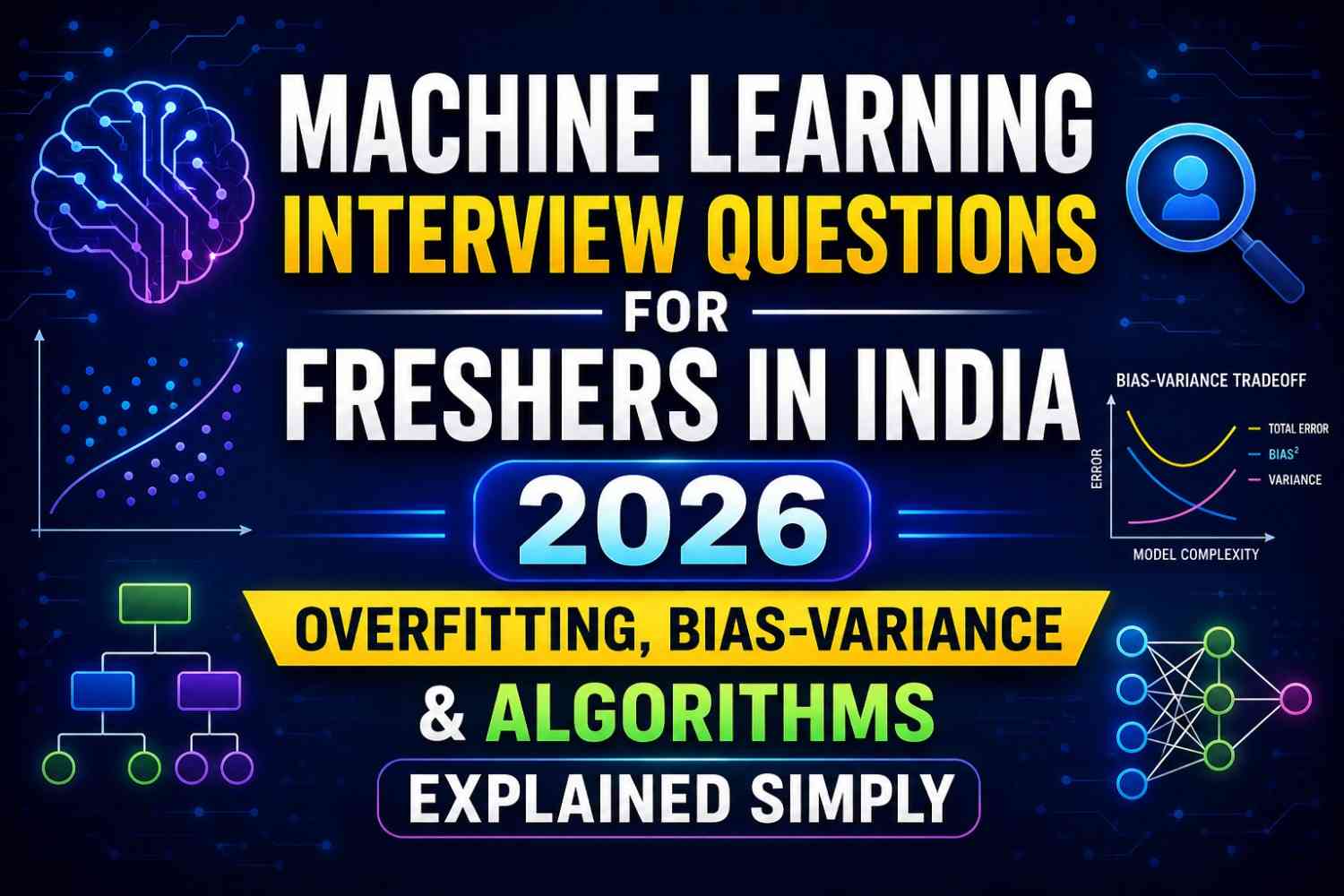
Machine learning is now one of the most sought-after skills in the Indian job market—and for freshers, the interview can feel overwhelming. Where do you even start? What do interviewers actually ask? How deep do you need to go? This complete guide to machine learning interview questions for freshers in India 2026 answers all of that—with simple explanations, clear answers, and real interview context.
The machine learning interview questions for freshers in India in 2026 in this guide are drawn from actual screening rounds at Indian tech companies, product startups, and analytics firms in 2026. They cover the concepts freshers are most frequently asked about—and most frequently struggle with—including overfitting, the bias-variance tradeoff, supervised vs. unsupervised learning, and key algorithms.
You do not need a PhD to answer these. You need clarity, conceptual understanding, and the ability to explain ideas simply. That is exactly what this guide builds.
What Indian Companies Expect from ML Freshers in 2026
Before the questions, some context on what interviewers asking machine learning interview questions for freshers in India 2026 are actually evaluating:
Conceptual clarity: Can you explain core ML concepts in your own words without relying on jargon?
Mathematical intuition: Not deep calculus, but understanding why certain algorithms work the way they do.
Python and library knowledge: Scikit-learn, pandas, numpy—can you implement basic models?
Problem framing: Can you identify which ML approach fits which business problem?
Intellectual honesty: Freshers who say “I am not sure but I think it works like this” are preferred over those who bluff confidently. Interviewers know you are a fresher.
Part 1: Fundamentals—Machine Learning Interview Questions for Freshers India 2026
Q1. What is machine learning? How is it different from traditional programming?
Answer: Machine learning is a branch of artificial intelligence where a system learns patterns from data and improves its predictions or decisions without being explicitly programmed with rules.
Traditional programming:
- Humans write explicit rules (if X, then Y)
- Rules process input to produce output
- Works well for well-defined, rule-based problems
Machine learning:
- The system is given input data and output examples
- The algorithm discovers the rules itself
- Works for complex patterns humans cannot easily specify
Simple analogy: In traditional programming, you tell a system, “If the email contains ‘FREE MONEY,’ mark as spam.” In machine learning, you show the system thousands of spam and non-spam emails, and it learns to identify spam patterns by itself—including patterns you never thought of.
This foundational distinction is tested in almost all machine learning interview questions for freshers India 2026 screenings.
Q2. What is the difference between supervised, unsupervised, and reinforcement learning?
Answer: This three-way distinction is one of the most fundamental machine learning interview questions for freshers in India 2026.
Supervised Learning:
- Training data includes labelled examples (input + correct output)
- Algorithm learns to predict output for new inputs
- Examples: Email spam classification, house price prediction, churn prediction
- Algorithms: Linear Regression, Logistic Regression, Decision Trees, Random Forest, SVM
Unsupervised Learning:
- Training data has no labels—only inputs
- An algorithm discovers hidden structure or patterns
- Examples: Customer segmentation, anomaly detection, topic modelling
- Algorithms: K-Means Clustering, DBSCAN, PCA, Autoencoders
Reinforcement Learning:
- An agent takes actions in an environment and receives rewards or penalties
- Agent learns a policy to maximise cumulative reward over time
- Examples: Game playing (AlphaGo), robotics, recommendation systems
- Not typically expected of freshers at a deep level
Knowing all three with a clear real-world example each is the complete answer expected for this machine learning interview question for freshers in India in 2026.
Q3. What are overfitting and underfitting? How do you fix them?
Answer: Overfitting and underfitting are the two most important failure modes in machine learning—and among the most commonly tested machine learning interview questions for freshers in India in 2026.
Overfitting: The model learns the training data too well — including noise and random fluctuations — and performs poorly on new, unseen data. The model has memorized rather than learned.
Signs: Very high training accuracy, much lower test/validation accuracy.
Underfitting: The model is too simple to capture the underlying pattern in the data. It performs poorly on both training and test data.
Signs: Low training accuracy and low test accuracy.
How to fix overfitting:
- Use more training data
- Apply regularisation (L1/Lasso or L2/Ridge penalty)
- Use dropout (in neural networks)
- Reduce model complexity (fewer features or shallower trees)
- Use cross-validation
- Apply early stopping during training
How to fix underfitting:
- Use a more complex model
- Add more relevant features (feature engineering)
- Reduce regularisation
- Train for more epochs (if neural network)
- Try ensemble methods
A complete, structured answer to this question is one of the biggest differentiators in machine learning interview questions for freshers in India’s 2026 screening rounds.
Q4. What is the bias-variance tradeoff?
Answer: The bias-variance tradeoff is one of the most conceptually important machine learning interview questions for freshers in India 2026—and one that many candidates explain poorly.
Bias: The error introduced by oversimplifying the model. High bias means the model makes strong, incorrect assumptions about the data. High bias → underfitting.
Variance: The model’s sensitivity to small fluctuations in the training data. High variance means the model changes dramatically with different training data. High variance → overfitting.
The tradeoff: Reducing bias tends to increase variance, and vice versa. The goal is to find the “sweet spot”—a model complex enough to capture real patterns (low bias) but not so complex that it fits random noise (low variance).
Visual way to explain it:
- High bias, low variance: Consistently wrong — like an archer who always shoots the same spot but far from the bullseye
- Low bias, high variance: Randomly scattered around the bullseye but not consistently hitting it
- Low bias, low variance: Consistently hitting the bullseye—this is the goal
This analogy demonstrates exactly the kind of clear, accessible thinking that interviewers value in machine learning interview questions for freshers in India 2026.
Q5. What is cross-validation, and why is it important?
Answer: Cross-validation is a technique for evaluating machine learning models more reliably than a simple train-test split.
The problem with a single train-test split: If you split your data 80/20 once, your test set evaluation depends heavily on which 20% you happened to select. You may get lucky (or unlucky) with that particular split.
K-Fold Cross-Validation:
- Split data into K equal folds (e.g., K=5)
- Train on K-1 folds, test on the remaining fold
- Repeat K times, each time using a different fold as the test set
- Average the K test scores for a more reliable performance estimate
Why it matters: It uses all available data for both training and validation, gives a more robust estimate of model performance, and helps detect overfitting. Cross-validation is standard practice in all professional ML work covered in machine learning interview questions for freshers in India 2026.
Part 2: Algorithms — Machine Learning Interview Questions for Freshers India 2026
Q6. Explain linear regression. What are its assumptions?
Answer: Linear regression models the relationship between a dependent variable (what you want to predict) and one or more independent variables (features) by fitting a straight line through the data.
Equation: y = β₀ + β₁x₁ + β₂x₂ + ... + ε
The model finds the coefficients (β values) that minimize the sum of squared differences between predicted and actual values—called Ordinary Least Squares (OLS).
Key assumptions:
- Linearity—the relationship between features and target is linear
- Independence — observations are independent of each other
- Homoscedasticity — constant variance of error terms across all values
- Normality of residuals — errors are normally distributed
- No multicollinearity — independent variables are not highly correlated with each other
Violations of these assumptions reduce the reliability of linear regression results. For machine learning interview questions for freshers in India in 2026, being able to name at least three assumptions is sufficient for most fresher-level interviews.
Q7. What is logistic regression, and how is it different from linear regression?
Answer: Despite its name, logistic regression is a classification algorithm—not a regression algorithm. It predicts the probability that an observation belongs to a particular class (typically binary: 0 or 1).
Key difference from linear regression:
| Feature | Linear Regression | Logistic Regression |
|---|---|---|
| Output | Continuous value | Probability (0 to 1) |
| Use case | Regression | Binary classification |
| Output function | Direct line | Sigmoid function |
| Loss function | Mean Squared Error | Log loss / Binary Cross-Entropy |
The sigmoid function squashes any input value into a range between 0 and 1—making it perfect for outputting probabilities. A threshold (typically 0.5) is then applied to convert probabilities to class labels.
Example use case: Predicting whether a loan applicant will default (1) or not default (0) based on income, credit score, and employment history.
This comparison is consistently among the most asked machine learning interview questions for freshers in India in 2026.
Q8. What is a decision tree? How does it handle overfitting?
Answer: A decision tree is a flowchart-like model that splits data into increasingly smaller groups based on feature values, creating a tree structure where leaves represent final predictions.
How it works:
- At each node, choose the feature and split value that best separates the data (using metrics like Gini impurity or information gain).
- Recursively split until a stopping condition is reached
- Each leaf node represents a class label (classification) or average value (regression)
The overfitting problem: Decision trees are highly prone to overfitting—a fully grown tree can perfectly memorize training data by creating highly specific rules for every data point.
How to control overfitting in decision trees:
- Max depth: Limit how deep the tree can grow
- Min. samples split: Require a minimum number of samples before a split
- Min samples leaf: Require a minimum number of samples at each leaf
- Pruning: Remove branches that provide little additional predictive power
- Use ensemble methods—Random Forest combines hundreds of trees to reduce variance
This is one of the most detailed answers expected in machine learning interview questions for freshers in India 2026 for candidates applying to analytics or data science roles.
Q9. What is Random Forest, and why is it better than a single decision tree?
Answer: Random Forest is an ensemble algorithm that builds many decision trees (often hundreds) during training and combines their predictions—through majority voting for classification or averaging for regression.
Why better than a single tree:
- Reduces overfitting—individual trees overfit differently; combining them cancels out the noise
- More stable — less sensitive to small changes in the training data
- Built-in feature importance—Random Forest naturally measures how much each feature contributes to predictions
- Handles missing values and high dimensionality reasonably well
The “Random” part: Each tree is trained on a random bootstrap sample of the data (bagging) AND at each split, only a random subset of features is considered. This ensures diversity among the trees, which is what makes the ensemble more powerful than any individual tree.
Random Forest is one of the most practical and commonly asked algorithms in machine learning interview questions for freshers in India 2026, and knowing it thoroughly is strongly recommended.
Q10. What is the difference between L1 and L2 regularization?
Answer: Regularization adds a penalty to the model’s loss function to discourage complex models and prevent overfitting. This is a frequently tested concept in machine learning interview questions for freshers in India 2026 for candidates applying to mid-tier companies and above.
L1 Regularization (Lasso):
- Adds the absolute value of coefficients as a penalty:
loss + λ∑|βᵢ| - Drives some coefficients exactly to zero—performs automatic feature selection
- Produces sparse models
- Best when you suspect many features are irrelevant
L2 Regularization (Ridge):
- Adds the squared value of coefficients as a penalty:
loss + λ∑βᵢ² - Drives coefficients toward zero but rarely exactly to zero
- All features are retained but with reduced influence
- Best when all features contribute somewhat but you want to reduce their magnitude
Elastic Net: Combines both L1 and L2 penalties—balances feature selection (L1) with coefficient shrinkage (L2). A flexible choice when you are uncertain which regularization is more appropriate.
Part 3: Model Evaluation Questions
Q11. What is the difference between precision, recall, and F1 score?
Answer: These are evaluation metrics for classification models—and one of the most critical machine learning interview questions for freshers in India in 2026.
Precision: Of all the positive predictions the model made, how many were actually positive? Precision = TP / (TP + FP)
Recall (Sensitivity): Of all the actual positives, how many did the model correctly identify? Recall = TP / (TP + FN)
F1 Score: The harmonic mean of precision and recall — balances both metrics. F1 = 2 × (Precision × Recall) / (Precision + Recall)
When to prioritize which:
- Precision critical: Spam detection—you do not want to mark genuine emails as spam (FP cost is high)
- Recall critical: Cancer detection—you do not want to miss actual cancer cases (FN cost is high)
- F1 Score: When you need to balance both—fraud detection and churn prediction
Q12. What is the ROC-AUC curve?
Answer: The ROC (Receiver Operating Characteristic) curve plots the true positive rate (recall) against the false positive rate at various classification thresholds. AUC (Area Under the Curve) summarizes the ROC curve as a single number.
AUC interpretation:
- AUC = 1.0 → perfect model
- AUC = 0.5 → model is no better than random guessing
- AUC = 0.85 → good model; correctly ranks a positive above a negative 85% of the time
Why it is useful: ROC-AUC is threshold-independent—it evaluates model performance across all possible decision thresholds, making it more informative than accuracy alone (especially for imbalanced datasets). This is standard evaluation knowledge expected in machine learning interview questions for freshers in India in 2026.
📍 Image 1 Placement: Place a clean diagram showing the bias-variance tradeoff curve — a U-shaped total error curve with bias decreasing and variance increasing as model complexity increases. ALT Text: Machine learning interview questions for freshers India 2026—bias-variance tradeoff diagram showing underfitting and overfitting zones
📍 Image 2 Placement: Place an ROC curve diagram here showing multiple classifier curves with the AUC shaded, including the random classifier diagonal line. ALT Text: Machine learning interview questions for freshers India 2026 — ROC AUC curve diagram for model evaluation
Quick Reference: Algorithm Cheat Sheet for Freshers
| Algorithm | Type | Use Case | Key Hyperparameters |
|---|---|---|---|
| Linear Regression | Supervised | Price/sales prediction | Regularisation strength |
| Logistic Regression | Supervised | Binary classification | C (inverse regularisation) |
| Decision Tree | Supervised | Both | Max depth, min samples |
| Random Forest | Supervised (Ensemble) | Both | n_estimators, max_features |
| K-Nearest Neighbours | Supervised | Both | K (number of neighbours) |
| SVM | Supervised | Classification | C, kernel, gamma |
| K-Means | Unsupervised | Clustering | K (number of clusters) |
| PCA | Unsupervised | Dimensionality reduction | n_components |
| Gradient Boosting | Supervised (Ensemble) | Both | Learning rate, n_estimators |
FAQ: Machine Learning Interview Questions for Freshers India 2026
Q1. How much mathematics do freshers need for ML interviews in India? For most fresher-level machine learning interview questions for freshers in India in 2026, you need conceptual understanding of linear algebra (matrices, vectors), basic calculus (gradient descent intuition), probability (Bayes’ theorem, distributions), and statistics (mean, variance, correlation). Deep derivations are not expected — understanding why concepts work is more important.
Q2. Which Python libraries should freshers know for ML interviews in India? At minimum: scikit-learn (model building, evaluation, preprocessing), pandas (data manipulation), numpy (numerical operations), and matplotlib/seaborn (visualization). Being able to implement a basic classification pipeline in scikit-learn in under 20 lines is a strong signal in machine learning interview questions for freshers in India’s 2026 technical rounds.
Q3. What ML projects should freshers have on their resume for Indian companies in 2026? Three to four well-documented projects on GitHub are strongly recommended. Classic starting points: Titanic survival prediction, house price regression, customer churn prediction, sentiment analysis. Projects that solve a real Indian business problem (crop yield prediction, IPL outcome prediction) stand out in machine learning interview questions for freshers’ India 2026 screening conversations.
Q4. Is deep learning expected knowledge in fresher ML interviews in India? For most fresher roles in India in 2026, deep learning is a bonus—not a requirement. A solid understanding of classical ML algorithms, feature engineering, and model evaluation covered in these machine learning interview questions for freshers in India 2026 is the primary expectation. For specific deep learning roles, neural network basics (layers, activation functions, backpropagation) are required.
Q5. Which Indian companies hire freshers for ML roles in 2026? Product companies: Flipkart, Swiggy, Zomato, PhonePe, CRED, Razorpay. IT services: TCS iON, Infosys BPM, and the Wipro Holmes team. Consulting: Mu Sigma, Tiger Analytics, Fractal Analytics, Absolutdata. Startups in fintech, healthtech, and edtech are also strong sources of fresher ML opportunities—all of which test the machine learning interview questions for freshers in India 2026 concepts covered in this guide.
Conclusion
The machine learning interview questions for freshers in India in 2026 covered in this guide represent the core conceptual foundation that every entry-level ML interview tests. You do not need to memorize research papers—you need to explain overfitting clearly, walk through a random forest with confidence, and articulate the bias-variance tradeoff in plain English.
Build that conceptual clarity first. Then build practical skills — implement these algorithms in Python, build real projects, and put them on GitHub. That combination of clear concepts and demonstrated practice is what consistently converts fresher candidates into opportunities.
Start today: Implement a logistic regression classifier on the Titanic dataset using scikit-learn. Then implement a random forest on the same data and compare results. Understanding why the results differ will teach you more than reading ten more articles about these machine learning interview questions for freshers India 2026.