 Owner@dscareers.site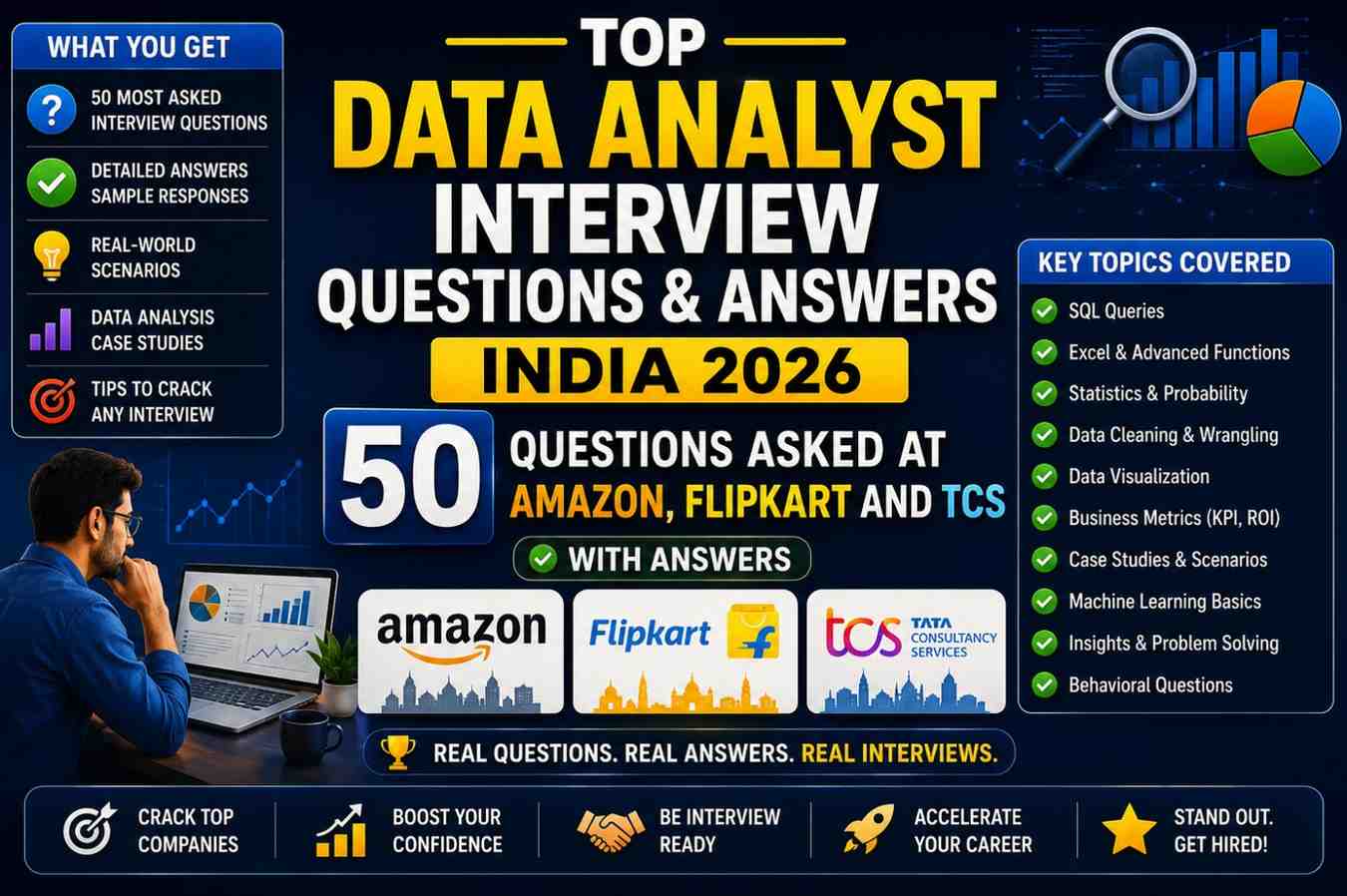
If you are preparing for a data analyst role in 2026, you already know that the interview process at top Indian and multinational companies has become more rigorous than ever. Whether you are targeting Amazon, Flipkart, TCS, Infosys, or a fast-growing startup, the top data analyst interview questions and answers India 2026 cover a wide range of technical, analytical, and behavioral topics that you must prepare for systematically.
This guide gives you the most comprehensive collection of top data analyst interview questions and answers in India for 2026, drawn from real interview experiences shared by candidates across Glassdoor, LinkedIn, and community forums. Each answer is crafted to match what interviewers in India’s top companies actually expect to hear in 2026.
Why Preparing Specifically for 2026 Indian Data Analyst Interviews Matters
The data analyst role in India has evolved significantly. Companies no longer just test SQL and Excel. The top data analyst interview questions and answers in India for 2026 now include machine learning basics, business case analysis, Python scripting, stakeholder communication, and data storytelling.
Understanding this shift is the first step. The second step is systematic preparation using the top data analyst interview questions and answers India 2026 categories covered in this guide:
- Technical questions (SQL, Python, Excel)
- Statistical and analytical questions
- Business and case study questions
- Behavioural and situational questions
- Domain-specific questions (e-commerce, finance, retail)
Section 1 — Core Technical Questions
These form the backbone of every top data analyst interview questions and answers India 2026 preparation session. Expect 5–10 technical questions in any serious interview round.
Q1. What is the difference between a data analyst and a data scientist?
Answer: A data analyst primarily focuses on interpreting existing data to answer specific business questions using SQL, Excel, and basic statistics. A data scientist builds predictive models using machine learning and advanced statistics. In the top data analyst interview questions and answers India 2026 context, analysts are expected to be expert storytellers with data, while data scientists are expected to build systems that generate new insights automatically.
Q2. What tools do you use as a data analyst?
Answer: The standard toolkit for a data analyst in India in 2026 includes:
- SQL — for data extraction and querying from databases
- Python (Pandas, NumPy, Matplotlib) — for data manipulation and visualisation
- Excel / Google Sheets — for quick analysis and reporting
- Power BI or Tableau — for interactive dashboards
- Google Analytics / Adobe Analytics — for web and product data
Mentioning 4–5 of these tools with context about how you used them is the expected answer pattern in top data analyst interview questions and answers in India in 2026.
Q3. What is a null value in SQL, and how do you handle it?
Answer: A NULL value in SQL represents missing or unknown data — it is not zero and not an empty string. To handle NULLs correctly:
- Use
IS NULLorIS NOT NULLin WHERE clauses - Use
COALESCE(column, default_value)to replace NULLs with a fallback value - Use
IFNULL(column, 0)in MySQL for simple replacements - Be careful in aggregate functions—and
AVG()ignore NULLs by default
Q4. Explain the difference between INNER JOIN, LEFT JOIN, RIGHT JOIN, and FULL OUTER JOIN.
Answer: This is one of the most frequently asked top data analyst interview questions and answers in India for 2026 SQL topics.
- INNER JOIN — returns only rows where there is a match in both tables
- LEFT JOIN — returns all rows from the left table and matching rows from the right; NULLs for non-matches on the right
- RIGHT JOIN — all rows from the right table; NULLs for non-matches on the left
- FULL OUTER JOIN — returns all rows from both tables; NULLs where there is no match on either side
Example use case at Flipkart: LEFT JOIN the orders table with the returns table to find all orders that were never returned.
Q5. What is a window function in SQL? Give an example.
Answer: Window functions perform calculations across a set of rows related to the current row without collapsing the result into one row. Unlike GROUP BY, the individual rows remain visible.
sql
SELECT
  employee_id,
  department,
  salary,
  RANK() OVER (PARTITION BY department ORDER BY salary DESC) AS salary_rank
FROM employees;
This query ranks employees by salary within each department—a classic pattern in top data analyst interview questions and answers in India’s 2026 SQL rounds at companies like Amazon and Flipkart.
Q6. What is the difference between WHERE and HAVING in SQL?
Answer: WHERE filters rows before any grouping occurs. HAVING Filters groups after one has been applied.
sql
-- WHERE filters individual rows
SELECT * FROM orders WHERE amount > 500;

-- HAVING filters grouped results
SELECT customer_id, SUM(amount)
FROM orders
GROUP BY customer_id
HAVING SUM(amount) > 5000;
This is a guaranteed question in top data analyst interview questions and answers in India’s 2026 SQL rounds.
Q7. How would you find duplicate rows in a SQL table?
Answer:
sql
SELECT email, COUNT(*) as count
FROM users
GROUP BY email
HAVING COUNT(*) > 1;
This finds all email addresses that appear more than once in the users table—a real-world deduplication problem commonly tested in top data analyst interview questions and answers in India in 2026.
Q8. What is normalization in databases, and why does it matter for analysts?
Answer: Normalization is the process of organizing a database to reduce data redundancy and improve data integrity. For a data analyst, understanding normalization matters because:
- It explains why data is spread across multiple tables (requiring JOINs)
- It helps diagnose why query results might have duplicated rows
- It guides decisions about when to use denormalised structures for analytical reporting
The three main normal forms (1NF, 2NF, and 3NF) are frequently tested in top data analyst interview questions and answers in India’s 2026 database theory questions.
Section 2 — Python and Data Manipulation Questions
Python questions are increasingly common in top data analyst interview questions and answers in India’s 2026 rounds, particularly at product companies like Flipkart, Swiggy, Meesho, and Amazon India.
Q9. How do you read a CSV file and display the first 5 rows in Python?
Answer:
python
import pandas as pd
df = pd.read_csv('data.csv')
print(df.head())
Q10. How do you handle missing values in a pandas DataFrame?
Answer:
python
# Check for missing values
df.isnull().sum()

# Drop rows with any missing values
df.dropna(inplace=True)

# Fill missing values with mean of column
df['column'].fillna(df['column'].mean(), inplace=True)

# Fill with a specific value
df['column'].fillna(0, inplace=True)
Choosing the right strategy (drop vs fill) depends on business context—explaining this distinction is what separates strong answers in top data analyst interview questions and answers in India 2026 Python rounds.
Q11. What is the difference between `.loc` and .iloc in Pandas?
Answer:
loc— label-based indexing. Selects rows and columns using their labels/namesilocInteger position-based indexing. Selects rows and columns using numeric positions (0, 1, 2…)
python
df.loc[0:5, 'column_name']    # rows 0–5, by label
df.iloc[0:5, 2]               # rows 0–5, column at position 2
Q12. How do you merge two DataFrames in Pandas?
Answer:
python
merged_df = pd.merge(df1, df2, on='customer_id', how='left')The how parameter accepts ‘inner,’ ‘left,’ ‘right,’ or ”outer’—directly mirroring SQL JOIN types, which is why top data analyst interview questions and answers in India 2026 interviewers often test both simultaneously.
Q13. How would you find the top 5 customers by total order value using Python?
Answer:
python
top_customers = (
    df.groupby('customer_id')['order_value']
    .sum()
    .sort_values(ascending=False)
    .head(5)
    .reset_index()
)
Section 3 — Statistics and Analytical Thinking Questions
Statistics questions are among the most differentiating areas in top data analyst interview questions and answers India 2026 rounds. Many candidates fail here due to poor conceptual clarity.
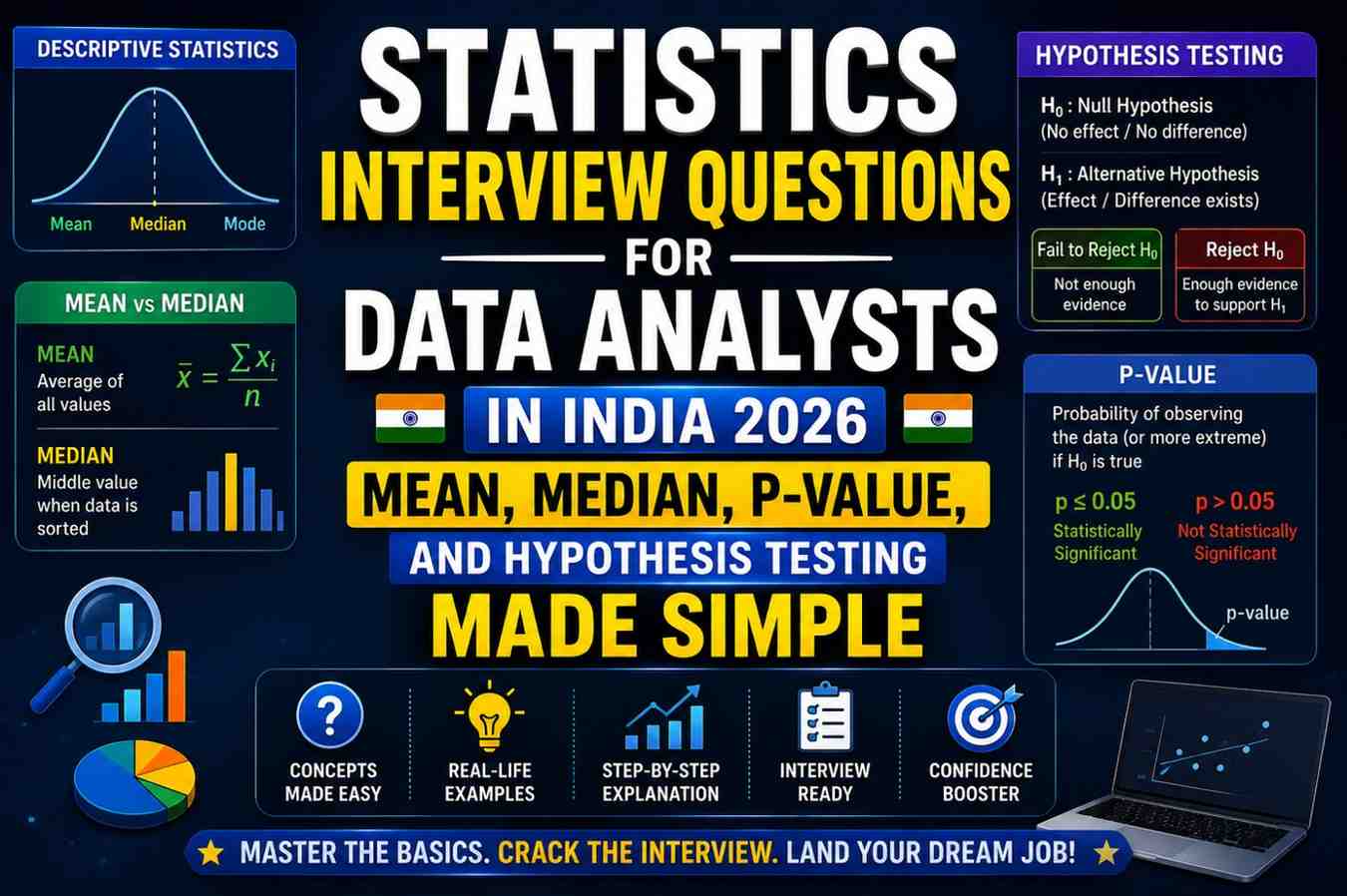
Q14. What is the difference between mean, median, and mode? When would you use each?
Answer:
- Mean — arithmetic average; use when data is normally distributed without extreme outliers
- Median — middle value when sorted; use when data has outliers (e.g., salary data, house prices in India)
- Mode — most frequent value; use for categorical data (e.g., most common city in customer data)
In Indian e-commerce data (Flipkart, Amazon India), salary and order value distributions are heavily skewed—making the median the more honest measure. This contextual explanation is what interviewers at companies featured in top data analyst interview questions and answers, India 2026, lists expect.
Q15. What is a p-value, and what does it tell you?
Answer: A p-value measures the probability of observing results at least as extreme as the current data, assuming the null hypothesis is true. A p-value below 0.05 (the standard threshold) means the result is statistically significant—you reject the null hypothesis.
Example: You run an A/B test on Flipkart’s homepage. The new design shows a 4% higher click-through rate. The p-value is 0.03. Since 0.03 < 0.05, the result is statistically significant, and the new design genuinely performs better.
Q16. What is a confidence interval?
Answer: A confidence interval gives a range within which the true population parameter is expected to fall, with a specified level of certainty (usually 95%). A 95% CI of [3.2%, 6.8%] means we are 95% confident the true conversion rate improvement lies somewhere between 3.2% and 6.8%.
Q17. What is correlation vs. causation? Give an Indian business example.
Answer: Correlation means two variables move together. Causation means one variable directly causes a change in another. They are not the same.
Indian example: Ice cream sales and drowning rates are both high in summer — they are correlated. But ice cream does not cause drowning. Both are caused by a third variable: hot weather. Confusing correlation and causation in business decisions is a common and costly mistake, which is why this is tested in top data analyst interview questions and answers in India’s 2026 rounds at analytical companies.
Q18. What is standard deviation, and why does it matter in data analysis?
Answer: Standard deviation measures how spread out values are around the mean. A low SD means values are clustered closely around the mean. A high SD means values are widely scattered.
In customer analytics, if average order value is ₹850 with an SD of ₹50, most customers order between ₹800 and ₹900. If SD is ₹500, your customer base is extremely diverse in spending behavior, requiring different segmentation strategies.
Section 4 — Business and Case Study Questions
These distinguish senior from junior candidates in top data analyst interview questions and answers in India in 2026.
Q19. How would you measure the success of a new feature launched on Flipkart’s app?
Answer: Define clear metrics before launch:
- Primary metric — the KPI the feature is designed to improve (e.g., add-to-cart rate, checkout completion rate)
- Secondary metrics — supporting metrics that should also improve (session duration, return visits)
- Guardrail metrics — metrics that should NOT worsen (page load time, crash rate, refund rate)
Run an A/B test: show the new feature to 50% of users (treatment group) and keep the old experience for the other 50% (control group). After a sufficient sample size and time, compare metrics using a t-test or chi-square test with p < 0.05 as a significance threshold.
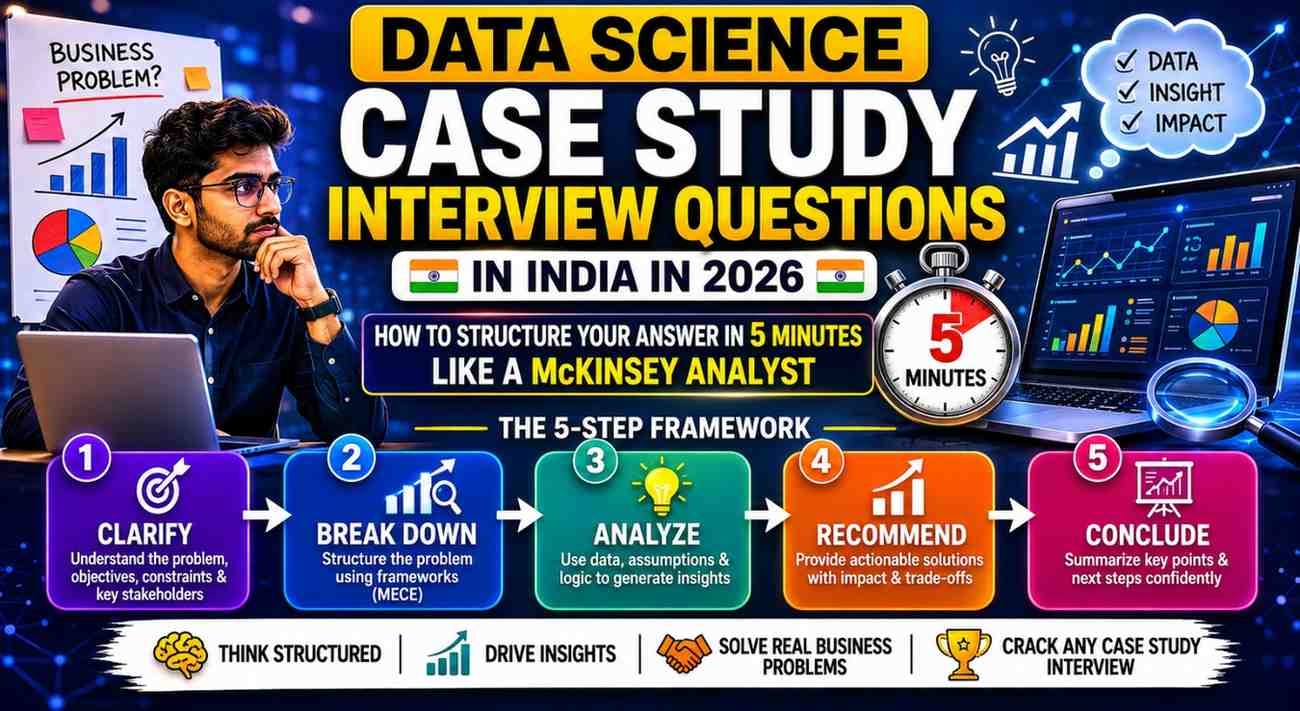
Q20. You notice a sudden 30% drop in daily active users. How do you investigate?
Answer: This is a classic top data analyst interview question and answer for India in 2026. Use a structured framework:
- Validate the data — check if it is a tracking/logging issue first
- Segment the drop by platform (Android/iOS/Web), geography, user type, acquisition channel
- Check timeline — did any deployment, marketing campaign, or external event coincide?
- Compare cohorts—is it new users, returning users, or both dropping?
- Check funnel — at which step of the user journey did users drop off?
- Form a hypothesis — propose likely root causes with supporting data
- Recommend action — propose next steps to confirm and fix the issue
Q21. How would you define and measure customer churn for a subscription-based Indian OTT platform?
Answer: Customer churn rate = (Customers lost in period / Customers at start of period) × 100
For an OTT platform: a customer is “churned” if they cancel their subscription or do not renew within the grace period. Measure churn monthly, quarterly, and annually. Segment churn by plan type, content genre preference, acquisition channel, and geography. Build a churn prediction model using logistic regression or random forest to flag high-risk users before they churn.
Section 5 — Behavioural and HR Questions
Every top data analyst interview questions and answers India 2026 guide must include these commonly underestimated questions.
Q22. Tell me about a time you found an insight from data that changed a business decision.
Answer (STAR format):
- Situation: Our marketing team was allocating 70% of the ad budget to Google Ads
- Task: I was asked to review the ROI of all marketing channels
- Action: I built a cohort analysis in SQL and Python comparing customer LTV by acquisition channel
- Result: Found that email marketing had 3× higher LTV than Google Ads for our segment. The team reallocated 30% of the budget to email campaigns, improving quarterly ROI by 18%.
Q23. How do you explain a complex analysis to a non-technical stakeholder?
Answer: Use the “insight first, evidence second” approach. Lead with the business conclusion: “We are losing ₹2 crore annually to cart abandonment at the payment step.” Then support it with charts and simplified data. Avoid jargon. Use analogies. Always connect data findings to the decision the stakeholder needs to make.
Q24. How do you prioritize multiple data requests from different teams?
Answer: Evaluate requests on two dimensions — business impact and urgency. Use a 2×2 matrix: high impact + urgent = do immediately; high impact + not urgent = schedule next; low impact + urgent = delegate or quick fix; low impact + not urgent = deprioritize or decline. Communicate your prioritization transparently to all requestors.
Section 6 — Company-Specific Questions
Amazon India Questions
Q25. What metrics would you track for Amazon Prime membership growth in India?
Track: new Prime sign-ups per day/week, Prime trial-to-paid conversion rate, Prime churn rate, Prime-exclusive feature usage (Prime Video, Prime Music, and Early Access), and Prime member average order value vs. non-Prime member average order value.
Flipkart Questions
Q26. How would you measure the impact of the Big Billion Days sale on customer retention?
Compare 90-day retention rates of customers who made their first purchase during Big Billion Days vs. those who made their first purchase in a normal week. If Big Billion Days customers churn faster, the sale is attracting price-sensitive one-time buyers rather than loyal customers—a key insight for strategy.
TCS / Infosys Questions
Q27. What is ETL, and why does it matter for a data analyst?
ETL stands for Extract, Transform, Load. It is the process of pulling data from source systems, cleaning and transforming it, and loading it into a data warehouse for analysis. Understanding ETL pipelines helps analysts understand where data comes from, why it sometimes has quality issues, and how to trace data lineage when results look unexpected.
Comparison Table: Interview Focus by Company Type
| Company Type | SQL Weightage | Python Weightage | Business Case Weightage | Stats Weightage |
|---|---|---|---|---|
| Amazon / Flipkart (Product) | High | High | Very High | High |
| TCS / Infosys / Wipro (IT Services) | Very High | Medium | Low | Medium |
| Startups (Swiggy, Meesho, Zepto) | High | High | High | High |
| BFSI (HDFC, ICICI Analytics) | High | Medium | High | Very High |
| Consulting (Deloitte, EY) | Medium | Low | Very High | High |
Image Suggestions
Image 1 — Placement: After the introduction, a focused young Indian data analyst at a laptop with SQL code on screen and data visualization charts on a second monitor in a modern office. ALT text: “top data analyst interview questions and answers India 2026 — Indian data analyst preparing with SQL and Python”
Image 2 — Placement: After the statistics section, a whiteboard with statistical concepts—mean, median, p-value, and confidence interval—drawn in neat diagrams in an Indian office interview setting. ALT text: “top data analyst interview questions and answers India 2026—statistics concepts on whiteboard for interview preparation”
External Authority Links
- NASSCOM Data Analytics Trends India 2026—industry trends and skill demand for Indian data professionals
- Glassdoor India — Data Analyst Interview Reviews — real candidate interview experiences at top Indian companies
- LeetCode — SQL Practice Problems — best platform for SQL and Python interview preparation
- Kaggle — Data Science Learning — free datasets and courses for data analyst skill building
- Analytics Vidhya — Interview Preparation India — India’s largest data science community and learning platform
FAQs: Top Data Analyst Interview Questions and Answers India 2026
Q1. Which companies ask the hardest data analyst interview questions in India in 2026? Amazon India, Flipkart, Google India, and fast-growing startups like Swiggy, Meesho, and PhonePe ask the most rigorous top data analyst interview questions and answers in India in 2026—combining SQL, Python, statistics, and business case rounds across 4–6 interview stages.
Q2. How many rounds of interview should I expect for a data analyst role in India? Most mid-to-large Indian companies have 3–5 rounds: an online assessment (SQL/Python), a technical interview (SQL + stats), a case study round, a managerial round, and an HR round. Preparing all categories in this top data analyst interview questions and answers India 2026 guide covers all rounds.
Q3. Is Python mandatory for data analyst interviews in India in 2026? Python is expected at product companies (Amazon and Flipkart) and startups but less emphasized at traditional IT services companies (TCS, Infosys, and Wipro). For the most competitive roles in the top data analyst interview questions and answers in the Indian market in 2026, Python proficiency in Pandas and Matplotlib is strongly recommended.
Q4. How should I prepare for SQL in data analyst interviews in India? Practice on LeetCode (easy and medium SQL problems), the Mode Analytics SQL tutorial, and the HackerRank SQL section. Focus on JOINs, GROUP BY, window functions, subqueries, and CTEs—all of which appear consistently in top data analyst interview questions and answers in India 2026 SQL rounds.
Q5. What salary can I expect after clearing a data analyst interview in India in 2026? Entry-level data analyst salaries in India in 2026 range from ₹4–8 LPA at IT services firms to ₹8–18 LPA at product companies and startups. Senior analysts with 3–5 years of experience earn ₹15–35 LPA at top companies—making systematic preparation using the top data analyst interview questions and answers India 2026 resources worth every hour invested.
Conclusion
Cracking a data analyst interview at India’s top companies in 2026 requires more than memorizing answers. The top data analyst interview questions and answers in India for 2026 that actually get candidates hired are the ones that combine technical accuracy with business thinking and clear communication.
Use this guide as your complete preparation checklist. Practice SQL queries daily on LeetCode. Build Python Pandas fluency through real datasets on Kaggle. Study statistics concepts until they feel like common sense. And always frame your answers using the STAR method in behavioral rounds.
The top data analyst interview questions and answers in the India 2026 landscape reward candidates who are genuinely curious about data and can translate numbers into decisions. That is the standard — and this guide gives you everything you need to meet it.
Found this guide helpful? Bookmark it, share it with your preparation group, and drop your company-specific questions in the comments!