 Owner@dscareers.site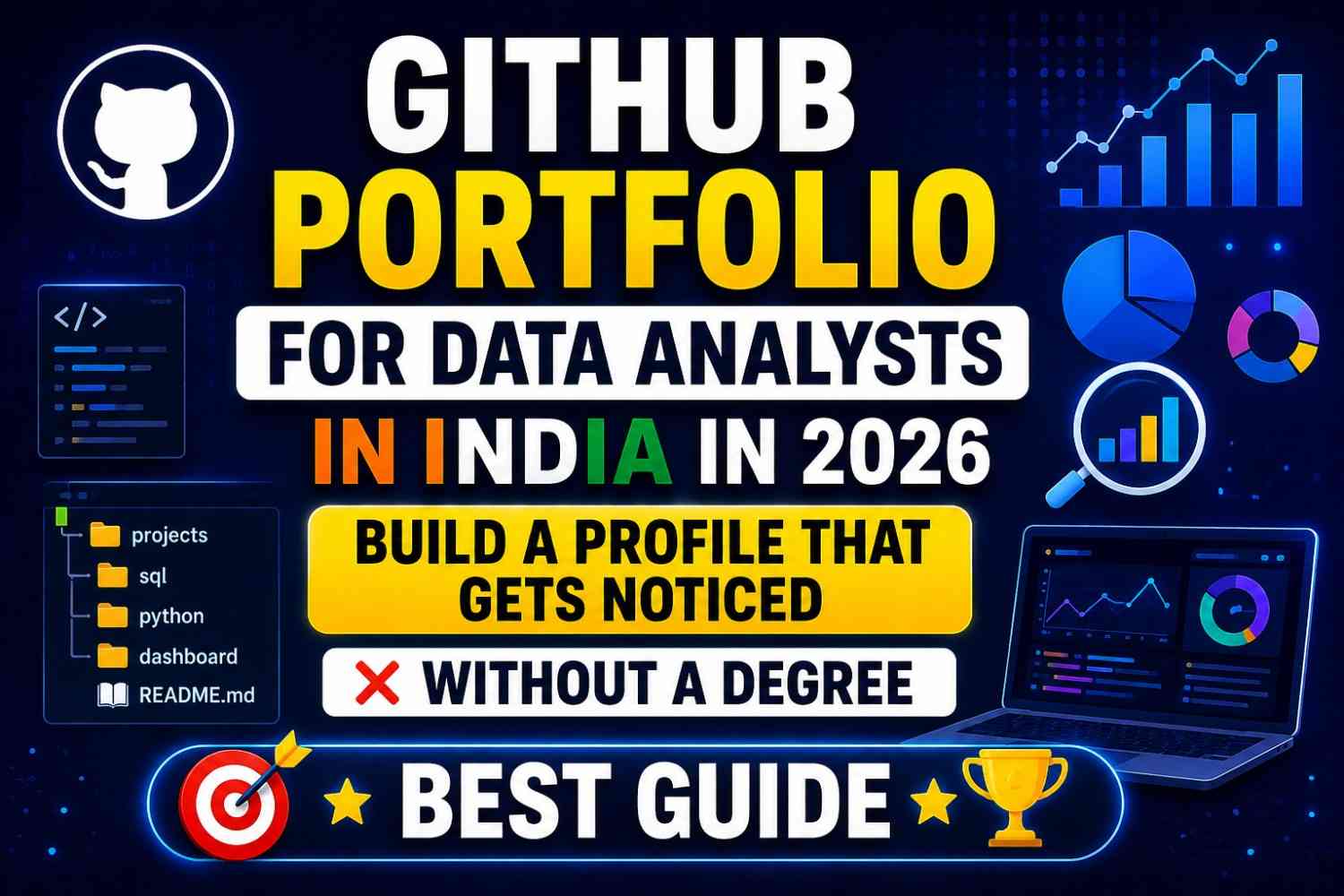
In 2026, a strong GitHub portfolio can do something that no degree from any Indian university can guarantee — it can prove, concretely and verifiably, that you can do the work of a data analyst. A well-constructed GitHub portfolio for data analysts India 2026 is visible to every recruiter who searches your name, speaks for itself in technical interviews, and directly compensates for gaps in formal education or work experience.
This guide covers exactly how to build, structure, and maintain a GitHub portfolio for data analysts in India in 2026 that recruiter teams at Indian tech companies and MNCs actively respond to.
Why GitHub Matters More Than Your Degree for Data Analyst Roles in India
Before diving into the how-to, understanding the shift behind the GitHub portfolio for data analysts in the 2026 India trend is important.
India produces approximately 1.5 million engineering graduates per year. The credential gap — the difference between a degree from IIT Bombay and one from a tier-3 engineering college — has historically been significant in hiring. But data science changed this dynamic.
When a hiring manager can see your Jupyter notebooks, read your analysis logic, review your code quality, and test your models, the college brand on your degree becomes secondary to the evidence in your repository. Multiple documented cases of candidates from non-IIT, non-NIT backgrounds landing roles at top Indian startups and MNCs specifically because of a strong GitHub portfolio confirm this shift.
A compelling GitHub portfolio for data analysts in India in 2026 levels the playing field in a way that nothing else in the Indian job market currently does.
Related Post: GitHub Portfolio for Data Analysts in India in 2026—Build a Profile That Gets Noticed Without a Degree: Best Guide
Step 1: Set Up Your GitHub Profile Correctly
Profile essentials:
- Profile photo: Professional headshot—this is not your resume; a face adds human connection
- Bio (160 characters): “Data Analyst | Python, SQL, Power BI | Building analytics projects | Open to opportunities”
- Location: Your city, India
- Website: Link to your LinkedIn profile
- Pinned repositories: Pin your 6 best projects—these are the first thing visitors see
Profile README: GitHub allows you to create a special repository (username/username) whose README appears on your profile page. This is one of the most underused features in the GitHub portfolio for data analysts in the India 2026 space. A well-designed profile README includes:
markdown
# Hi, I'm [Your Name] 👋

Data Analyst based in [City], India | Python • SQL • Power BI • Machine Learning

## 🔍 What I Build
- Customer analytics and churn prediction models
- Interactive BI dashboards with real business context
- SQL-based business performance analysis
- Time series forecasting for Indian market datasets

## 📊 Featured Projects
[Links to your 3 best projects with one-line descriptions]

## 🛠️ Tech Stack
Python | SQL | Power BI | Tableau | Scikit-learn | Pandas | Git

## 📫 Contact
[LinkedIn] | [Email] | [Kaggle profile]
This README is often the first impression a recruiter gets from your GitHub portfolio for data analysts in India in 2026—make it clear, professional, and scannable in under 30 seconds.
Step 2: Structure Each Project Repository
Every project in your GitHub portfolio for data analysts in India in 2026 needs to be a well-organized repository that non-technical readers (HR) can understand and technical readers (data team) can evaluate.
Required files in every project repo:
1. README.md (most important file) Structure:
# Project Title
## Problem Statement
[1–2 sentences: what business problem does this solve?]

## Dataset
[Source, size, key features]

## Methodology
[Step-by-step: EDA → Preprocessing → Modelling → Evaluation]

## Results
[Key metrics: accuracy, RMSE, main insights with numbers]

## Business Insights
[3–5 actionable findings]

## Tech Stack
Python 3.10 | Pandas 2.0 | Scikit-learn 1.3 | Matplotlib | Seaborn

## How to Run
[Simple installation and execution instructions]
2. Jupyter Notebook (.ipynb)
- Clean, well-commented cells with markdown explanations between code blocks
- Visualisations with clear titles and axis labels
- A clear narrative flow from data loading to final insights
3. requirements.txt Lists all Python package dependencies so anyone can reproduce your work.
4. data/ folder: Include the dataset (if small enough) or a clear link to where it can be downloaded. Include a data dictionary explaining each column.
5. images/ folder (optional but powerful) Include 2–3 key visualization screenshots from your project. These appear when GitHub renders the README, making your repository visually compelling before anyone reads a line of code.
Step 3: The 6 Projects That Define a Strong Data Analyst GitHub Portfolio
A GitHub portfolio for data analysts in India in 2026 that gets noticed needs at least 6 repositories, covering these six capability areas:
Repository 1 — EDA and Storytelling: A comprehensive exploratory analysis of an Indian market dataset (Zomato, IPL, stock market, census data). Focus on clear visualizations and business-context insights. This demonstrates your ability to derive meaning from raw data.
Repository 2 — SQL Analysis Project: A collection of well-organized SQL queries solving business questions on a structured database. Include a clear problem statement for each query and the insight it generates. Host on GitHub with a .sql file and a README showing results.
Repository 3 — Machine Learning End-to-End: Customer churn prediction, fraud detection, or price prediction—a complete ML workflow from raw data to evaluated model. This is the centerpiece of most strong GitHub portfolios for data analysts in India in 2026.
Repository 4 — Visualization Dashboard: Power BI (.pbix file) or Tableau Public embedded visualization. Include screenshots and a business context explanation in the README. This directly demonstrates the dashboard skills requested in 70%+ of job descriptions.
Repository 5 — Time Series / Forecasting: ARIMA, Prophet, or LSTM-based forecasting on a time-indexed dataset. Stock prices, sales data, weather data — any dataset with a temporal dimension works.
Repository 6 — Domain-Specific or Unique Project: Something that shows personality and genuine curiosity — an analysis of your city’s traffic data, IPL player performance analytics, or Indian housing price trends. This “wild card” project is often the one recruiters mention when reaching out because it reveals genuine interest beyond template projects.
Step 4: Code Quality Standards That Make Technical Reviewers Respect Your Work
A GitHub portfolio for data analysts in India in 2026 is not just about having projects—it is about the quality of the code within them. Data team technical reviewers look for:
Well-commented code:
python
# Calculate customer lifetime value using RFM segmentation
# Recency: days since last purchase | Frequency: total orders | Monetary: total spend
rfm = df.groupby('CustomerID').agg({
    'InvoiceDate': lambda x: (reference_date - x.max()).days,  # Recency
    'InvoiceNo': 'count',  # Frequency
    'TotalAmount': 'sum'   # Monetary
}).reset_index()
Modular notebook structure: Divide notebooks into clearly labeled sections: 1. Data Import, 2. Data Cleaning, 3. EDA, 4. Feature Engineering, 5. Modelling, 6. Evaluation, 7. Insights and Recommendations.
No hardcoded file paths: Use relative paths (../data/sales.csvnot absolute paths).
Clean visualizations: Every plot needs a title, labeled axes, and a brief interpretation in the markdown cell that follows it.
Step 5: Activity and Consistency Signals
GitHub shows your contribution graph — the green squares representing daily commits. A GitHub portfolio for data analysts in India in 2026 with consistent activity over months is far more credible than a profile with 50 commits on one day followed by months of silence.
Building a consistent green graph:
- Commit improvements to existing projects (add better documentation, fix code comments, add new analyses)
- Add new datasets to existing projects
- Star and fork repositories related to your technical interests
- Contribute to public data science repositories—even documentation improvements count
Consistent activity signals exactly what data analytics teams want: a candidate who is continuously learning and building.
5 Frequently Asked Questions (From Google)
Q1: Do Indian recruiters actually look at GitHub profiles? Yes—increasingly so. At product companies (Razorpay, CRED, Meesho, Swiggy) and MNCs (Amazon, Google, Microsoft), technical data team members routinely review GitHub profiles before or during the interview process. A strong GitHub portfolio for data analysts in India in 2026 is reviewed by technical interviewers even when HR teams are less familiar with code repositories.
Q2: What programming language should my GitHub data analyst portfolio use? Python is the dominant language for Indian data analyst GitHub portfolios in 2026. SQL project repositories are also highly valued. R projects are relevant for BFSI and research roles. Having a mix of Python EDA, SQL business analysis, and one ML project covers the broadest range of employer expectations.
Q3: How many repositories should a data analyst have on GitHub in India? Six to ten well-documented projects is the ideal range for a GitHub portfolio for data analysts in India in 2026. Fewer than six suggests limited output; more than fifteen with poor documentation suggests a quantity-over-quality focus.
Q4: Should I include tutorial projects I followed on my GitHub? Only if you significantly extended them—added new analysis, different datasets, or meaningful customization. Pure tutorial reproductions with zero personalization are not worth showcasing. If a recruiter identifies your project as a verbatim tutorial reproduction (common for Kaggle starter notebooks), it damages your credibility.
Q5: Can a strong GitHub portfolio replace a computer science degree for data analyst jobs in India? While it cannot literally replace a degree requirement listed in a job posting, a compelling GitHub portfolio for data analysts India 2026 has demonstrably helped non-CS graduates bypass initial screening at multiple major Indian companies. Project evidence consistently outweighs degree brand in technical screening for companies with mature analytics-hiring processes.
Conclusion
A well-constructed GitHub portfolio for data analysts in India in 2026 is the most powerful career asset a data analyst can build outside of formal employment. It is visible, verifiable, searchable, and permanent. Start with two strong projects, build them to the documentation standard described in this guide, and add consistently over the following months. By the time you apply to your target companies, your GitHub profile will speak more compellingly for your abilities than any resume section can.