 Owner@dscareers.site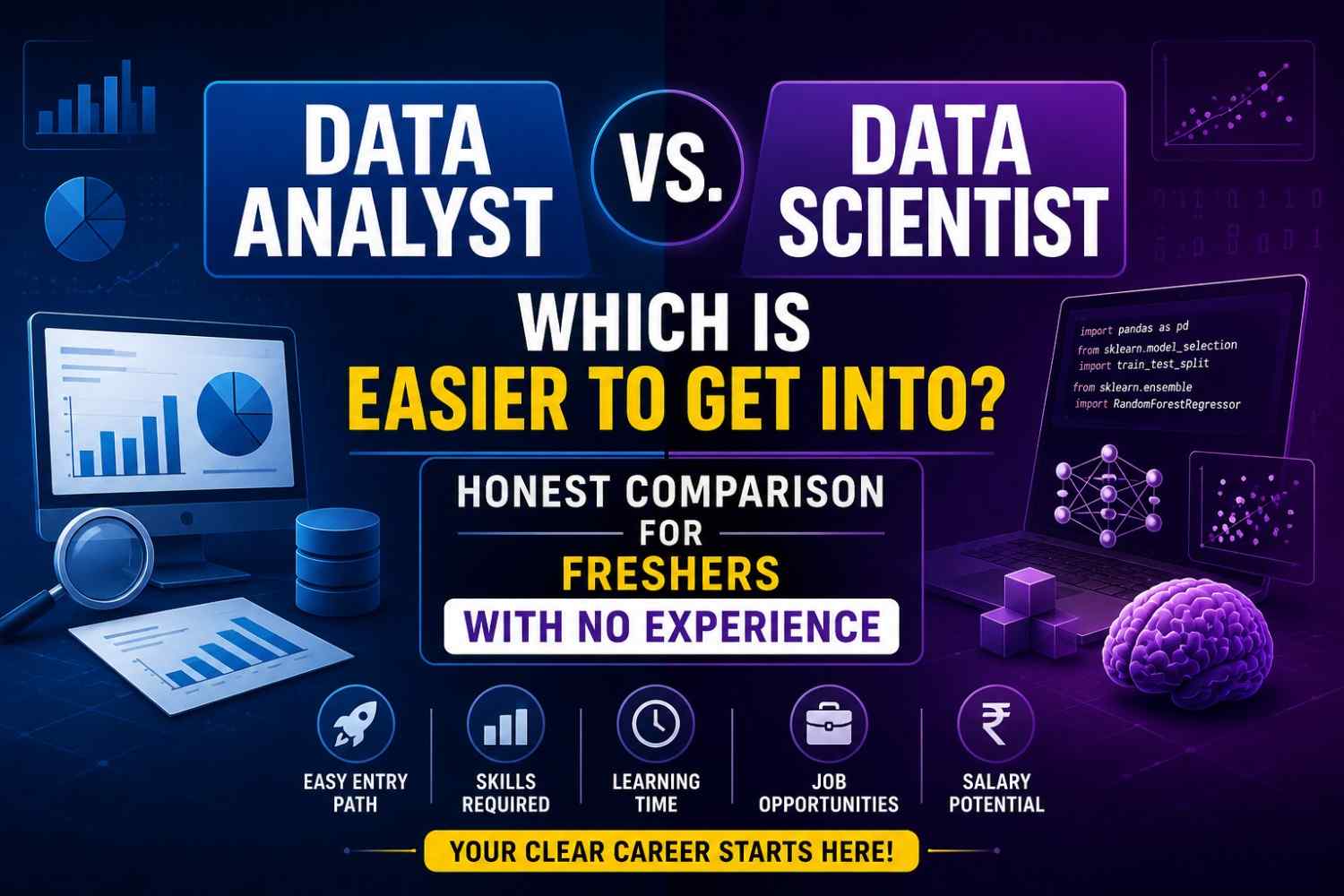
If you’re a fresher staring at two career paths and wondering which one will actually hire you first—this guide answers that question without sugarcoating. Data analyst vs. data scientist: which is easier to get into? is one of the most searched questions by data aspirants in India, and the honest answer is not always what career blogs say.
Data analyst vs. data scientist: which is easier to get into comes down to five dimensions: the prerequisite skills required to land your first job, the volume of entry-level openings available, the intensity of competition at the entry level, the time investment needed to become job-ready, and the reality of what Indian hiring managers actually look for in freshers.
This guide answers the data analyst vs. data scientist: which is easier to get into? question with complete honesty—including the uncomfortable truths that most career content creators avoid because they might discourage you from buying a course.
The Honest Answer: Data Analyst vs Data Scientist: Which Is Easier to Get Into
The direct answer: Data analyst roles are significantly easier to get into for freshers — especially those from non-CS backgrounds.
Here is why the data analyst vs. data scientist verdict, which is easier to get into, leans heavily toward analyst roles for most freshers:
1. Volume of openings: Naukri.com shows approximately 3–4 data analyst openings for every 1 data scientist opening in India at the fresher level. More openings means more chances.
2. Prerequisite depth: Getting to a minimum viable data analyst skill set (SQL + Excel + basic Python + Tableau) takes 4–6 months of focused self-study. Getting to a minimum viable data scientist skill set (Python + advanced statistics + machine learning + model building) takes 10–18 months for most learners.
3. Educational flexibility: Data analyst roles are regularly filled by graduates from B.Com, BBA, BSc (non-CS), and BA economics backgrounds. Data scientist fresher roles almost universally require CS, mathematics, or statistics educational backgrounds.
4. Interview complexity: Data analyst fresher interviews typically cover SQL, basic Python, case studies, and communication. Data scientist fresher interviews add machine learning theory, model evaluation, probability and statistics problems, and often a coding test.
Entry Requirements: Data Analyst vs Data Scientist: Which Is Easier to Get Into
| Requirement | Data Analyst | Data Scientist |
|---|---|---|
| Minimum Education | Any bachelor’s degree | Preferred: CS/Math/Stats |
| Core Technical Skills | SQL, Excel, Basic Python | Python, ML, Statistics |
| Portfolio Minimum | 2–3 dashboards + 1 SQL project | 2–3 ML projects with GitHub |
| Time to job-ready. | 4–6 months | 10–18 months |
| Certifications Valued | Google DA, IBM DA | Google ML, AWS ML, Kaggle |
| Typical Fresher Test | SQL + Excel + Case Study | SQL, Python, ML concepts, and stats |
This table makes the data analyst vs. data scientist, which is easier to get into, answer concrete—the analyst path has lower bars at every dimension.
Competition Level: Data Analyst vs Data Scientist: Which Is Easier to Get Into
While data analyst roles are easier to qualify for, they also attract far more competition:
Data analyst fresher applications per opening (India 2026):
- IT Services companies: 300–500 applications per opening
- Product companies: 500–1,000 applications per opening
- FAANG: 2,000+ applications per opening
Data scientist fresher applications per opening (India 2026):
- IT Services companies: 100–200 applications per opening
- Product companies: 200–500 applications per opening
- FAANG: 800–1,500 applications per opening
The data analyst vs. data scientist competition dynamic is nuanced: more people apply for analyst roles, but fewer people are qualified for scientist roles. Your success probability depends on which group you fall into.
[IMAGE 1 — Place after competition section]
Suggested Image: A side-by-side comparison infographic with two columns—”Data Analyst” and “Data Scientist”—each showing four metrics as horizontal progress bars: time to job-ready (DA: 4–6 months, DS: 10–18 months), job openings volume (DA: high, DS: medium), competition intensity (DA: very high, DS: high), and entry barrier (DA: medium, DS: high)—in a clean visual comparison format. ALT Text: “Data analyst vs data scientist: Which is easier to get into? Side-by-side infographic comparing time to job-ready, opening volume, competition, and entry barrier for both roles.”
The Minimum Viable Skill Set for Each Role
Minimum Viable Data Analyst Skill Set (4–6 Months)
Month 1–2: SQL + Excel
- SQL: SELECT, WHERE, GROUP BY, JOIN, subqueries, window functions
- Excel: VLOOKUP, PivotTables, conditional formatting, basic charts
Month 3: Python for Data Analysis
- Python basics (variables, loops, functions, list comprehensions)
- Pandas: DataFrames, filtering, aggregation, merging
- NumPy: Arrays, basic operations
- Matplotlib/Seaborn: Basic visualisation
Month 4: Tableau or Power BI
- Connect data sources
- Build interactive dashboards
- Create calculated fields and parameters
Month 5–6: Projects + Job Applications
- Build 2 SQL analysis projects (publicly available datasets)
- Build 2 Tableau/Power BI dashboards
- Start applying and iterate based on feedback
This 6-month path represents the fastest route through the data analyst vs. data scientist, which is an easier landscape to get into.
Minimum Viable Data Scientist Skill Set (10–18 Months)
Months 1–3: Python + Statistics foundations
- Advanced Python (OOP, exception handling, file I/O)
- Pandas + NumPy mastery
- Statistics: probability, distributions, hypothesis testing, regression
Months 4–6: Machine Learning fundamentals
- Supervised learning: Linear/logistic regression, decision trees, random forests, SVMs
- Unsupervised learning: K-means, PCA
- Model evaluation: Cross-validation, precision/recall, AUC-ROC
Month 7–9: Advanced ML + Tools
- Ensemble methods (XGBoost, LightGBM)
- Scikit-learn mastery
- Basic feature engineering
- Introduction to neural networks
Months 10–12: Projects + Specialisation
- 2–3 end-to-end ML projects on Kaggle or GitHub
- Choose a specialisation track (NLP, Computer Vision, or Tabular ML)
- Kaggle competition participation (builds credibility)
Month 13–18 (for competitive roles):
- Deep learning (TensorFlow or PyTorch)
- MLOps basics (model deployment, Flask API, Docker)
- LLM fine-tuning and prompt engineering
Background-Specific Advice: Data Analyst vs Data Scientist: Which Is Easier to Get Into
If you’re from CS/engineering: Both paths are accessible. Given your programming background, the question becomes a career preference—do you prefer business-facing analytics work or technical ML development? The data analyst vs. data scientist: Which is easier to get into? The answer for you is “both are realistic within 6–10 months.”
If you’re from mathematics/statistics: You have the strongest foundation for data science—your background gives you the statistical depth that most CS graduates lack. A data scientist is the natural choice. The data analyst vs. data scientist: which is easier to get into? The answer for you: data science, because your degree gives you a major head start on the hardest prerequisite.
If you’re from Commerce/BBA/Economics: A data analyst is the realistic first target. Your business and financial understanding is a genuine advantage for analytics roles. Build SQL and Python skills over 4–6 months and apply aggressively. Transition to data science after 2–3 years of analyst experience if desired.
If you’re from Humanities/Arts: Data analyst is the only realistic direct path. Focus on SQL, Excel, Tableau, and developing very strong business communication skills—the combination of data skills with communication ability is scarce and valued.
[IMAGE 2 — Place before FAQs]
Suggested Image: A decision flowchart titled “Which data role should you target first?” — starting with “What is your educational background?” branching into CS/Engineering → both paths; Math/Stats → Data Scientist; Commerce/Economics → Data Analyst; Arts/Humanities → Data Analyst—with timeline estimates and first step recommendations at each endpoint. ALT Text: “Data analyst vs data scientist: Which is easier to get into? Decision flowchart showing which role to target first based on educational background for Indian freshers.”
The First Job Strategy: Making the Data Analyst vs Data Scientist Which Is Easier to Get Into Decision Work for You
Regardless of which path you choose, data analyst vs. data scientist, which is easier to get into analysis-wise, these strategies maximize your success rate:
Strategy 1: Start with internships A 3-month data analyst or data scientist internship (paid or unpaid) is often the fastest path to a full-time offer. Internship interview bars are lower than full-time bars, and many companies convert interns to FTEs.
Strategy 2: IT services as a launchpad. TCS, Infosys, Wipro, and Cognizant all have data analytics/science practices that hire freshers with lower bars than product companies. Joining an IT firm and building domain expertise for 1–2 years before moving to a product company is a proven path.
Strategy 3: Kaggle + GitHub portfolio A Kaggle profile with completed competitions ranks, plus a GitHub with 3–5 well-documented projects, is the most universally respected portfolio signal in the data analyst vs. data scientist landscape, which is easier to get into.
Strategy 4: Niche domain application Target companies in sectors where your non-data background gives you an edge. Commerce graduates targeting fintech or BFSI analytics roles. Science graduates targeting healthcare analytics. This domain advantage reduces competition between data analysts and data scientists, which makes it easier to get into the selection process.
FAQs: Data Analyst vs Data Scientist: Which Is Easier to Get Into
Q1: Is the data analyst vs. data scientist, which is easier to get into, question different for tier-2 college graduates? A: Yes. Tier-2 college graduates face higher competition barriers for data scientist roles at top product companies, which heavily filter on educational pedigree at the fresher level. The data analyst vs. data scientist: which is easier to get into? The answer for tier-2 graduates is strongly “start with analyst” and use work experience + portfolio to transition.
Q2: How long before I can apply for jobs as a data analyst vs. data scientist? Which is easier to get into terms with? A: For data analyst roles: 4–6 months of focused skill building. For data scientist roles: 10–18 months minimum. These are realistic timelines for learners spending 3–4 hours daily on structured learning.
Q3: Does the data analyst vs. data scientist, which is easier to get into, answer change if I have a master’s degree? A: Significantly. An MSc in Statistics, M.Tech in CS, or IIT/IISc master’s degree changes the data scientist path from “difficult entry” to “competitive entry” at top companies. Master’s graduates routinely land data scientist roles at product companies with 6–9 months of additional ML skill building.
Q4: Are there data analyst vs data scientist which is easier to get into differences by industry? A: Yes. IT services (easier to get in as an analyst). Fintech/Payments (easier as an analyst with domain knowledge). E-commerce (harder; both roles require product thinking). Healthcare analytics (analyst easier with domain). Gaming/Ad-tech (data scientist is easier if you have an ML background).
Q5: How important are certifications for a data analyst vs. a data scientist? Which is easier to get into decisions? A: Certifications (Google Data Analytics, IBM Data Analyst, Coursera ML Specialization) are useful resume signals but are not substitutes for projects and a portfolio. Indian hiring managers in 2026 weigh practical projects significantly more than course completions when evaluating freshers.
Conclusion
Data analyst vs. data scientist: which is easier to get into has a clear answer for most freshers: the data analyst path is faster, has more openings, requires less prerequisite learning, and is accessible from a broader range of educational backgrounds. But “easier to get into” doesn’t mean “less “valuable”—analyst roles are the foundation of a strong data career.
The data analyst vs. data scientist: Which is easier to get into? The decision should be made based on your honest assessment of your current skills, your available learning time, your educational background, and your long-term career goals. Both paths lead to excellent careers—the best path is the one you can actually travel successfully.
Start building your portfolio today, apply consistently, iterate on feedback, and remember: the first data job is always the hardest to get—every subsequent one gets progressively easier.
External Links
- https://www.kaggle.com — Kaggle: Data Science Competitions and Datasets
- https://www.naukri.com/data-analyst-jobs-freshers — Naukri: Fresher Data Analyst Jobs India
- https://www.coursera.org/professional-certificates/google-data-analytics — Google Data Analytics Certificate
- https://www.coursera.org/specializations/machine-learning-introduction — Andrew Ng ML Specialisation
- https://github.com/trending/python — GitHub Trending: Data Science Projects