
 Owner@dscareers.site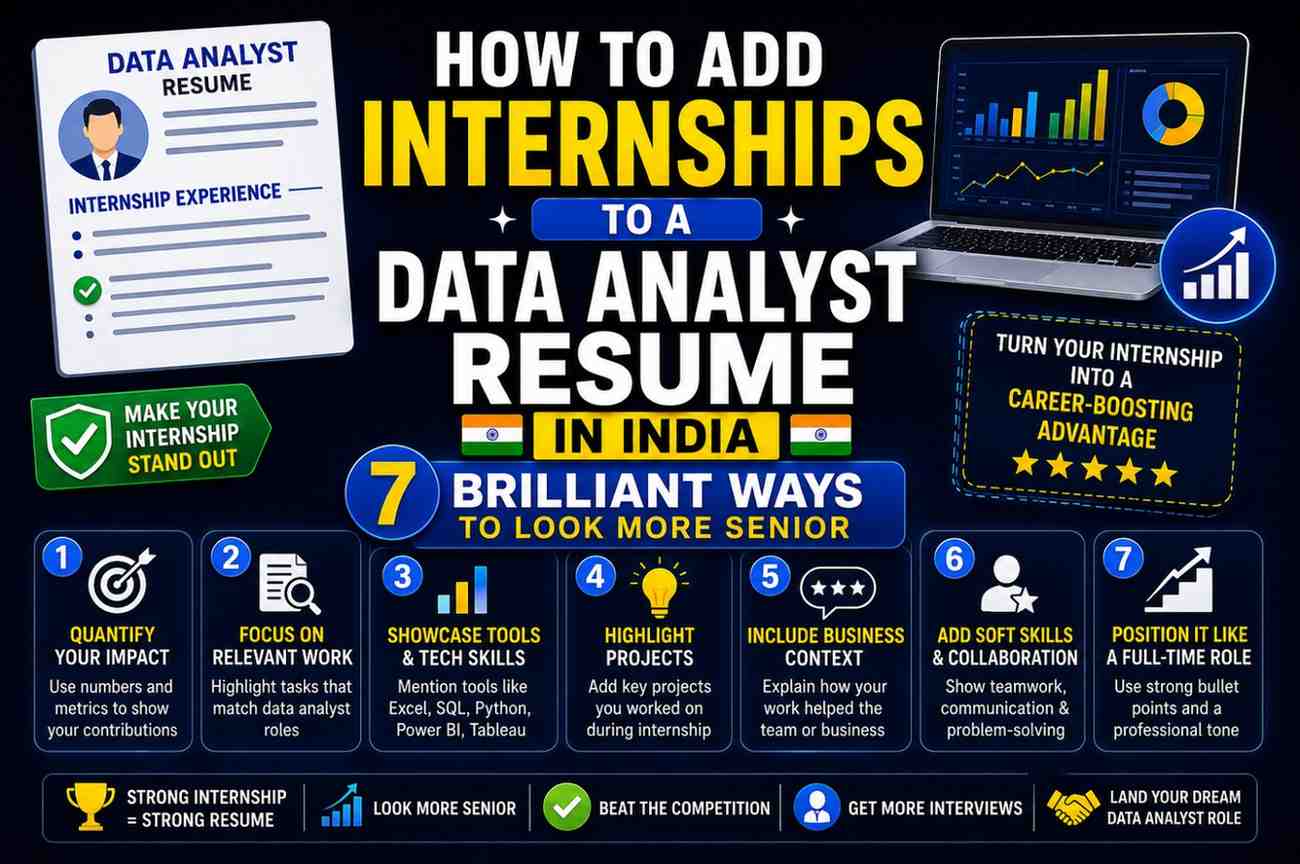
A two-month data analytics internship at a startup, a summer placement at a consultancy, or even a self-arranged virtual internship with a small business — these experiences feel modest when you are writing your resume. But to a hiring manager reviewing 200 applications from candidates with zero professional exposure, even the smallest genuine internship is a significant differentiator. The problem is not the experience itself—the problem is that most Indian candidates do not know how to add internships to a data analyst resumes in India that hiring teams actually value, and they end up underselling the most powerful section their resumes could offer.
This guide teaches you exactly how to add internships to a data analyst resume India recruiters respond to, with formatting templates, bullet-writing frameworks, positioning strategies, and before-and-after examples that transform weak internship entries into compelling evidence of professional capability.
Related Posts: Data Analyst Resume’s Projects Section in India 2026—5 Must-Have Projects That Get You Shortlisted Best Explanation
Why Your Internship Is More Valuable Than You Think
Before diving into the mechanics of how to add internships to data analyst resumes in India, you need to understand why you are almost certainly undervaluing your own experience.
Most Indian interns believe their work was “basic support,” “just cleaning data,” or “not significant enough to mention properly.” This self-assessment is almost universally wrong — and it is costing you interview calls.
Consider what you actually did during your internship through the eyes of a hiring manager comparing you to a candidate with zero professional experience:
You worked with real company data—not a Kaggle dataset designed to be clean and convenient, but messy, incomplete, real-world organizational data. You received actual business requirements from actual stakeholders who had actual deadlines. You produced deliverables that real people used for real decisions. You operated within a professional environment—Slack channels, standups, manager reviews—which means you understand how data work functions in an organizational context. And you have at least one person in the industry who can speak to your professional conduct.
Every single one of these is a genuine differentiator over a candidate who has only ever worked on personal projects. The fundamental insight behind how to add internship to data analyst resume India effectively is this: your internship is proof of professional-level application, not just academic learning. Present it accordingly.
Where to Place Your Internship on the Resume
Section placement is the first structural decision in how to add internship to data analyst resume India resume architecture. Two approaches work well depending on the nature of your internship.
Option A — Dedicated “Internships” Section (After Projects, Before Education)
This is the best placement for freshers with one or two clearly defined internship roles where you have describable deliverables. Placing it after projects but before education keeps the most impressive content at the top while still front-loading projects, which, for freshers, carry more technical weight.
When to use this: one or two internships of 1–3 months, real analytical deliverables, and describable tools and outcomes.
Option B — “Work Experience” or “Professional Experience” Section
For internships of 3 months or longer with substantial output, using the label “Work Experience” rather than “Internships” is entirely legitimate. An internship is work experience — the label is not dishonest, and it removes the junior connotation of “intern” from the hiring manager’s first impression.
When to use this: Internship of 3+ months, multiple deliverables, measurable outcomes, genuine team integration.
Option C — “Internships and Projects” Combined Section
When your internship work and your personal projects are closely related in scope and quality, combining them under one section creates a powerful unified evidence block. This approach to how to add an internship to a data analyst resume in India works particularly well when your internship project is comparable in complexity to your personal projects—it elevates the internship by association and contextualizes your projects with professional credibility.
Section header options by strength:
- “Professional Experience” — strongest framing, appropriate for 3+ month internships
- “Work Experience” — solid, widely accepted for all internship durations
- “Internships and Projects” — transparent and effective for combination sections
- “Internships” — straightforward, use only when internship duration is very short
The Exact Format for Each Internship Entry
This is the structural core of how to add internships to data analyst resume India applications that impress. Every internship entry should follow this precise format:
DATA ANALYST INTERN  [or most accurate functional title]
Company Name, City  |  Month Year – Month Year  (X months)
[One-line company descriptor if company is not widely known]

-  [Achievement bullet 1 — action verb + tool + specific work + quantified outcome]
-  [Achievement bullet 2 — action verb + tool + specific work + quantified outcome]
-  [Achievement bullet 3 — business impact, stakeholder interaction, or scale context]
Tools Used: Python, SQL, Power BI, Excel  [tailored to actual tools used]
Why this format works for ATS and human readers:
The functional title before the company name ensures ATS keyword matching registers “Data Analyst” even if your actual designation was “Summer Intern.” The tools line at the bottom creates additional keyword density for ATS scanning. The achievement bullets — written correctly — demonstrate professional-level output. This is the formatting foundation of any strong approach to how to add internships to data analyst resumes in India resume sections.
The Achievement Bullet Framework: From Weak to Powerful
The most common failure in how to add internships to a data analyst resume in India is the difference between responsibility bullets and achievement bullets. This distinction is everything.
Responsibility bullet: Describes what you were supposed to do. Achievement bullet: Describes what you actually accomplished and what it produced.
The STAR-D Formula for internship bullets: Every bullet should answer: Specific tool + Task performed + Actual data/context + Result + Data point (number)
Template: “[Action Verb] [specific dataset or system] using [specific tool] to [business objective] and [quantified outcome or business impact].”
12 Real Internship Bullet Transformations
These before-and-after transformations are the most practical part of understanding how to add internships to a data analyst resume in India. Read each pair and apply the same transformation logic to your own experience.
Transformation 1 — Data Cleaning ❌ Before: “Worked on data cleaning and preparation tasks.” ✅ After: “Cleaned and standardised a 45,000-record customer database using Python (Pandas), resolving 2,300 duplicate entries and reducing missing value rate from 18% to 0.4%—improving downstream CRM reporting accuracy for the sales team.”
Transformation 2 — Dashboard Creation ❌ Before: “Created dashboards for the team” ✅ After: “Built 3 interactive Power BI dashboards tracking weekly KPIs (revenue, order volume, return rate) for 5 product managers, reducing manual weekly reporting effort by an estimated 4 hours per cycle.”
Transformation 3 — SQL Queries ❌ Before: “Wrote SQL queries to extract data” ✅ After: “Wrote 15+ SQL queries using multi-table JOINs, CTEs, and window functions (LAG, RANK) to extract customer cohort retention data from a 500K-record PostgreSQL database for the growth analytics team”
Transformation 4 — Data Analysis ❌ Before: “Helped with data analysis projects” ✅ After: “Contributed to customer segmentation analysis using K-means clustering (K=4) on 12,000 active users in Python (Scikit-learn), identifying 4 distinct behavioural personas that informed the Q3 email campaign targeting strategy.”
Transformation 5 — Reporting ❌ Before: “Generated weekly reports for management” ✅ After: “Automated a weekly Excel report using Python (openpyxl and Pandas) that previously required 3 hours of manual compilation—reducing report generation time to under 10 minutes and eliminating formula errors.”
Transformation 6 — Presentations ❌ Before: “Presented findings to the team” ✅ After: “Presented data-driven insights to a cross-functional stakeholder group of 8, including the VP of Marketing, using a Tableau dashboard to communicate a 31% decline in mobile conversion rate and its seasonal pattern.”
Transformation 7 — ETL/Data Pipeline ❌ Before: “Worked on ETL processes” ✅ After: “Assisted in building a Python-based ETL pipeline that ingested daily sales data from 3 source APIs, cleaned and transformed 12,000 records per run, and loaded into a PostgreSQL database for downstream BI reporting.”
Transformation 8 — Exploratory Analysis ❌ Before: “Performed exploratory data analysis” ✅ After: “Conducted EDA on a 6-month e-commerce transaction dataset (92,000 records) using Pandas and Seaborn, identifying weekend purchase peaks and a negative correlation (r = -0.72) between delivery time and repeat purchase rate”
Transformation 9 — Business Insights ❌ Before: “Analysed data and provided insights to the manager.” ✅ After: “Identified that customers acquired through referral channels had 2.4x higher 90-day retention than paid acquisition channels—insight derived from cohort analysis in SQL and presented to the growth manager, influencing budget reallocation discussion.”
Transformation 10 — Excel/Spreadsheet Work ❌ Before: “Used Excel to analyse business data.” ✅ After: “Developed an Advanced Excel model using Pivot Tables, INDEX-MATCH, and conditional formatting to track 15 sales representatives’ monthly performance against targets, used in weekly team review meetings.”
Transformation 11 — Market Research ❌ Before: “Did market research and competitive analysis” ✅ After: “Compiled and analysed competitor pricing data across 8 Indian D2C brands using web scraping (BeautifulSoup) and Excel, identifying a ₹200–₹400 price gap opportunity in the 18–25 urban female segment.”
Transformation 12 — Survey Data Analysis ❌ Before: “Analysed survey results” ✅ After: “Analysed 840-response customer satisfaction survey using Python (Pandas, Matplotlib), performing sentiment categorisation and NPS calculation—identified 3 recurring complaint themes that were escalated to the product team”
Each transformation follows the same how to add internship to data analyst resume India principle: replace vague process descriptions with specific, quantified, outcome-driven achievement statements.
How to Handle Specific Internship Situations
Not every internship fits the ideal template. Here is how to handle the most common edge cases in how to add internship to data analyst resume. India applications:
Situation 1: Virtual or Remote Internship
Post-2020, virtual internships are standard and carry no stigma in Indian hiring. Present them identically to in-person roles. Do not mark them as “virtual” unless the application specifically asks or the remote nature is somehow relevant. The work done is what matters — not the location.
Situation 2: Unpaid Internship
Entirely legitimate work experience. An unpaid internship where you did real analytical work is vastly more valuable on your resume than no internship at all. Present it with the same format, and never mention the compensation status on the resume.
Situation 3: Internship at a Small or Unknown Company
Add a brief parenthetical descriptor after the company name to give context: “DataEdge Analytics Pvt. Ltd. (Pune-based retail analytics startup)” or “GreenLeaf Agri Solutions (agricultural data consultancy, 40 employees).” This prevents the recruiter from assuming the company is irrelevant and helps them understand the industry context of your work.
Situation 4: Internship in a Non-Data Field With Some Data Work
This is extremely common — marketing, HR, operations, or finance internships often include substantial data work that candidates undersell. If your marketing internship involved campaign data analysis, your HR internship involved attrition analytics, or your operations role included logistics data — lead with that work.
Use a functional title that reflects the analytical component: “Marketing Data Analyst Intern” or “HR Analytics Intern.” In your bullet points, focus exclusively on data-related activities. This approach to how to add internship to data analyst resume India for non-traditional backgrounds is legitimate and highly effective.
Situation 5: Multiple Short Internships (1–4 Weeks Each)
List the most data-relevant one if it has describable deliverables. For very short stints with no real output, it is better to omit them than include them with nothing meaningful to say. One strong internship entry beats three weak ones.
Situation 6: Internship From a Certificate Course or Bootcamp
Several Indian platforms (Internshala, upGrad, Analytics Vidhya, and Learnbay) include structured “industry projects” or “mentored internships” as part of their courses. These are legitimate—list them as internships with the project host’s name. Be prepared to describe what was real vs. simulated if asked in an interview.
The Senior-Looking Positioning Strategies
Beyond bullet quality, these advanced strategies in how to add internship to data analyst resume India presentations make your experience read as more senior than a raw reading of “2-month intern” would suggest.
Strategy 1 — Lead With Impact, Not Process
Always open your bullet with the outcome or context that makes the work sound significant, and then explain the method. “Improved weekly reporting efficiency by 75%” reads more senior than “used Python to automate a report.”
Strategy 2 — Name the Stakeholders
Mentioning that you “presented to the VP of Marketing” or “delivered insights to a cross-functional team of 6” signals professional-environment experience that purely project-based candidates cannot claim.
Strategy 3 — Use Scale Numbers
Dataset sizes (45,000 records), user volumes (12,000 active users), time savings (4 hours per week), and accuracy metrics (0.4% missing value rate) all add credibility and specificity that make a brief experience sound substantial.
Strategy 4 — Reference Business Decisions Your Work Informed
The most senior-sounding internship bullets connect your analytical output to an actual business action: “influencing budget reallocation,” “incorporated into Q3 targeting strategy,” and “used in product review meeting.” This is the highest-tier version of how to add internships to a data analyst resume in India — it demonstrates that your work had real consequences.
Strategy 5 — List Tools Explicitly at the End of Each Entry
A “Tools Used” line after your bullets creates keyword density and visually signals technical maturity. It also helps recruiters quickly scan your tool exposure without parsing every bullet.
What NOT to Include in Your Internship Section
Knowing what to leave out is equally important in how to add internship to data analyst resume. India’s execution:
Do not include:
- “Assisted with” or “helped with” language—always own your contribution directly
- Compensation details—never mention whether the internship was paid or unpaid
- “Certificate of Completion” unless it was from a genuinely recognised programme
- Tasks that were entirely personal (making tea, filing physical documents, basic data entry with no analysis component)
- Generic statements like “gained exposure to the corporate environment”—meaningless”
- Dates without months (year only)—always include month and year for credibility
- Confidential business metrics—approximate or generalise sensitive company data
Integrating Your Internship With the Rest of Your Resume
A strong how to add internship to data analyst resume India’s strategy does not treat the internship in isolation—it connects it to the broader resume narrative.
Connect internship tools to skills section: Every tool mentioned in your internship bullets should also appear in your skills section, reinforcing competency claims with professional evidence.
Connect internships to the projects section (where appropriate): If your internship involved a significant project, you can reference it briefly in both the experience section (context and team collaboration) and the projects section (technical methodology and results). This dual-section appearance signals substantial work.
Mirror internship language in your summary. If your internship was in e-commerce analytics, your professional summary should mention e-commerce analytics. If you built dashboards during your internship, your summary should highlight dashboard development. Consistency across resume sections is a signal of thoughtful self-presentation that is strong. How to add internships to data analyst resumes is demonstrated by Indian candidates.
Use internship-derived keywords throughout: If your internship exposed you to BigQuery, cohort analysis, or specific Indian market datasets, use those terms in your skills list, summary, and project descriptions wherever accurate — creating a keyword-consistent resume that ATS systems reward with higher match scores.
Sample Full Internship Section: Complete Example
PROFESSIONAL EXPERIENCE

DATA ANALYST INTERN
Meratrade Analytics Pvt. Ltd., Mumbai  |  June 2025 – August 2025  (3 months)
(Mumbai-based e-commerce analytics firm serving 15+ D2C brands)

-  Analysed a 92,000-record customer transaction dataset using Python (Pandas, Seaborn),
   identifying a 31% drop in repeat purchase rate among customers with delivery times
   exceeding 5 days — insight presented to the client success team and used in a
   logistics partner review

-  Built 2 Power BI dashboards tracking weekly sales KPIs (GMV, order volume, return rate,
   CAC) for 3 brand clients, reducing manual Excel-based reporting by approximately
   5 hours per week per client

-  Wrote 12 SQL queries using CTEs and window functions (LAG, LEAD, RANK) to extract
   6-month cohort retention data from a PostgreSQL database, producing a retention
   curve analysis showing 43% Month-1 retention and 22% Month-3 retention across
   the client's customer base

-  Automated a daily data quality check script in Python that flagged 200+ anomalous
   records per day from the ingestion pipeline, preventing downstream reporting errors
   that previously required manual correction

Tools Used: Python (Pandas, Seaborn, Matplotlib), SQL (PostgreSQL), Power BI, Advanced Excel
This example demonstrates what a well-executed “how to add internship to data analyst resume India” entry looks like in practice—specific, quantified, professional, and technically detailed without revealing confidential data.
5 Frequently Asked Questions (From Google)
Q1: Should I include a 1-month internship on my data analyst resume in India? Yes, if it involved real data work with describable deliverables. Even a 4-week internship where you wrote SQL queries, cleaned data, or built a basic dashboard is legitimate and valuable on a fresher resume. The core framework of how to add internship to data analyst resume India applies fully to short-duration roles — the key is whether you can write two to three achievement bullets with specific tools and outcomes.
Q2: What job title should I use for my internship if my actual title was just “intern”? Use the functional title that most accurately reflects the work you did. If you were performing data analysis, write “Data Analyst Intern.” If primarily building dashboards, write “Business Intelligence Intern.” If your role spanned analysis and some ML work, write “Data Science Intern.” Using a functional title is standard practice and not dishonest — it accurately describes the nature of your work.
Q3: How many bullet points should I write per internship on a data analyst resume? Two to four bullet points per internship is the ideal range. Each should describe a specific, quantified achievement. More than four risks dilute the section with weaker entries. Fewer than two may undersell legitimate contributions. The quality benchmark in how to add internship to data analyst resume India’s writing is every bullet must have at least one number and one specific tool.
Q4: Can I mention company-confidential data in my internship bullets? You can describe the type, scale, and domain of data without revealing specific sensitive business numbers. “Analyzed monthly revenue data across 5 product lines” is appropriate. ” Analyzing ₹47 crore monthly revenue data, revealing a Q2 shortfall, likely reveals sensitive information. When in doubt, approximate: “analyzed multi-crore revenue dataset across 5 product categories” conveys scale without compromising confidentiality.
Q5: My internship was in marketing, not data analytics. Should I still include it on a data analyst resume? Yes — if you can extract any analytical work from the experience. If your marketing internship involved campaign data analysis, performance reporting, or customer segmentation, include it under a functional title like “Marketing Data Analyst Intern” and focus exclusively on the data components in your bullets. This approach to how to add internships to data analyst resume India applications from non-traditional backgrounds is entirely legitimate and widely practiced.
Conclusion
Understanding how to add internship to data analyst resume What India hiring managers find compelling comes down to a single fundamental shift: stop describing your responsibilities and start documenting your achievements. The before-and-after transformations in this guide demonstrate that the gap between a weak internship entry and a strong one is not about the work you did—it is entirely about how precisely and confidently you describe it.
Use the STAR-D bullet framework, place your internship prominently in the resume structure, connect its tools to your skills section, and treat every quantifiable outcome — however small it may feel — as evidence worth including. Your 2-month internship, presented with the specificity and confidence this guide provides, is a more powerful application asset than you have been giving it credit for.
For further resume guidance tailored to Indian data analytics hiring, explore the full resume series at Naukri’s career resources and review peer-reviewed applications on LinkedIn’s job insights hub.