 Owner@dscareers.site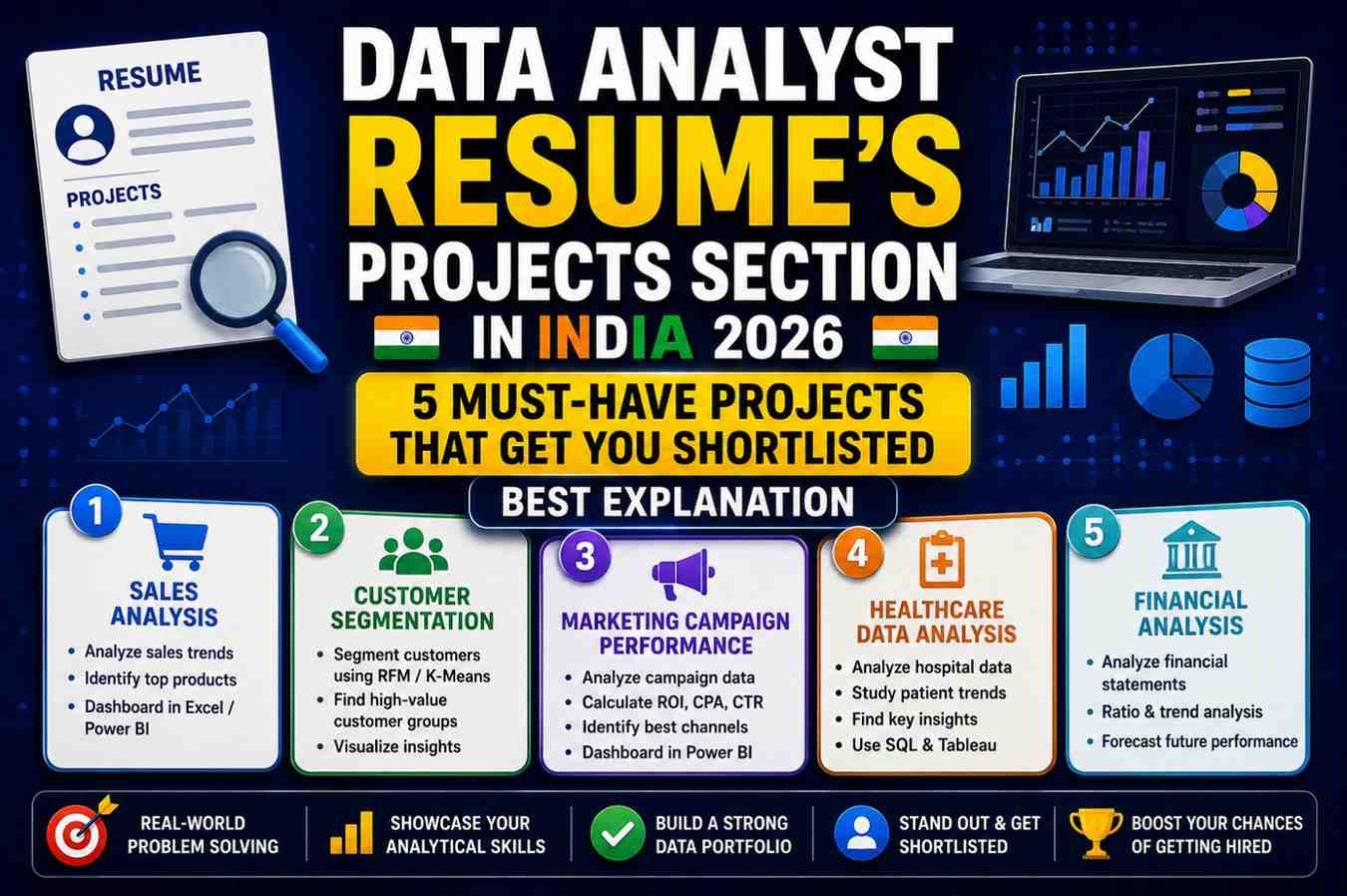
Ask any senior data analyst at an Indian tech company what they look at first on a fresher’s resume, and the answer is almost universally the same: projects. Not education, not certifications, not the skills list — projects. The data analyst resume’s projects section in India 2026 is the single section that determines whether you get a call or a rejection, and yet it is consistently the most poorly executed part of fresher resumes across the country.
This guide delivers five specific portfolio projects—with recommended datasets, tools, methodology, and results presentation—that will transform your data analyst resume projects section in India 2026 from a liability into your strongest asset.
Why the Projects Section Makes or Breaks Fresher Applications
Before building the ideal data analyst resume projects section India 2026, understand why this section carries disproportionate weight in the hiring decision.
A fresher applicant’s resume has a fundamental credibility challenge: they are asking someone to pay them to do something they have never been paid to do before. The only way to bridge this gap is with concrete evidence that you can do the work — and that evidence takes the form of completed projects.
A recruiter reviewing your data analyst resume’s projects section in India 2026 is asking three implicit questions:
- Can this person actually work with real data (not just describe tools)?
- Can they communicate findings clearly and quantifiably?
- Does their analytical thinking match what we need in this role?
Five well-executed projects answer all three questions decisively. Here is exactly what those five projects should be.
Project 1: Customer Churn Prediction (E-commerce / Telecom Domain)
Why this project? Customer churn analysis is one of the most commonly cited business problems in Indian data analyst job descriptions—at telecom companies (Airtel, Jio), e-commerce platforms (Flipkart, Amazon), and SaaS businesses alike. Including it in your data analyst resume projects section in India 2026 immediately signals business relevance.
Recommended dataset: IBM Watson Telco Customer Churn dataset (available free on Kaggle—7,043 customer records, 21 features including contract type, tenure, monthly charges, and churn label).
Tools: Python (Pandas, Scikit-learn, Matplotlib, Seaborn), SQL for initial data exploration, optional Power BI for dashboard
What to build:
- Complete EDA with visualisations of churn distribution, feature correlations, and customer segment analysis
- Data preprocessing: handle missing values, encode categorical variables, scale numerical features
- Build 3 classification models: logistic regression (baseline), random forest, and XGBoost
- Compare model performance using accuracy, precision, recall, F1, and AUC-ROC
- Identify top 5 churn predictors using feature importance
- Optional: build a simple interactive dashboard showing churn risk by customer segment
Results to quantify and present:
- Best model accuracy (aim for 82–88% with proper tuning)
- AUC-ROC score
- Top 3 churn drivers identified
- Business recommendation (e.g., “Customers on month-to-month contracts with tenure under 12 months show 3.2x higher churn probability—targeted retention offers for this segment would impact approximately 1,850 customers”)
Resume entry template for this project: “Customer Churn Prediction | Python, Scikit-learn, XGBoost, Seaborn | github.com/[username]/churn-prediction
- Analysed IBM Telco dataset (7,043 records) to identify churn drivers using EDA, logistic regression, random forest, and XGBoost
- Achieved 87.3% accuracy and 0.84 AUC-ROC with XGBoost after hyperparameter tuning and SMOTE-based class balancing
- Identified contract type, tenure, and monthly charges as top 3 churn predictors; recommended retention strategy targeting 1,850 high-risk customers”
This project entry is what the data analyst resume’s projects section for the India 2026 benchmark demands: specific, quantified, and business-contextualized.
Project 2: Sales and Revenue Dashboard (Business Intelligence)
Why this project? Every company needs business intelligence dashboards. Showing you can build one demonstrates Power BI or Tableau proficiency — tools that appear in 70%+ of Indian data analyst job descriptions in 2026.
Recommended dataset: Superstore Sales Dataset (available on Kaggle and Tableau Public — 10,000 orders across product categories, regions, and customer segments). Alternatively, use an Indian-context dataset: FMCG sales data available on Kaggle under “Indian sales dataset.”
Tools: Power BI (primary) or Tableau, Excel for initial data exploration, Python/SQL for data preparation
What to build:
- Multi-page interactive Power BI dashboard with:
- Executive summary page (total revenue, profit, orders, YoY growth)
- Regional performance map (India state-wise sales if using Indian dataset)
- Product category profitability analysis
- Customer segment analysis with CLV indicators
- Time-series trend analysis with seasonality identification
Results to quantify:
- Number of interactive visualisations
- Key insights discovered (e.g., “West region contributes 43% of revenue but only 31% of orders—the highest average order value”)
- Any actionable business findings
This BI project is essential for the data analyst resume projects section in India 2026 because it directly mirrors the day-to-day work of a junior analyst in a corporate environment.
Project 3: SQL-Based Business Analysis (Database Querying and Reporting)
Why this project? SQL proficiency is listed as a required skill in virtually every data analyst job posting in India. A dedicated SQL project demonstrates this skill far more convincingly than “SQL” in a skills list.
Recommended dataset: The Northwind database (Microsoft’s classic retail database — available free on GitHub) or a music streaming database (available on Mode Analytics public warehouse). In the Indian context, the IRCTC booking dataset available on data.gov.in provides excellent material.
Tools: MySQL or PostgreSQL (free, widely used in India), Python for visualisation of query results, Jupyter Notebook for presentation
What to build: A series of business questions answered entirely through SQL queries, presented as a structured analysis:
- Revenue analysis: total sales by product, category, region, and time period
- Customer analysis: top customers by value, purchase frequency, recency (RFM analysis)
- Performance trends: month-over-month and year-over-year growth calculations using window functions
- Cohort retention analysis using CTEs
- Inventory/supply chain queries: stockout risk identification, supplier performance
Advanced SQL to showcase: window functions (RANK, LAG, LEAD, ROW_NUMBER), CTEs, subqueries, CASE statements, date/time functions, and GROUP BY with HAVING. Including these in your data analyst resume projects section, the India 2026 SQL project signals intermediate-to-advanced SQL capability.
Results to quantify: Number of business questions answered, query complexity (mention CTEs and window functions), key insights extracted
Project 4: Indian Market or Social Data Analysis (EDA and Storytelling)
Why this project? This project demonstrates two capabilities that generic Kaggle projects do not—the ability to find your own data and the ability to tell a meaningful story relevant to the Indian business context. Both are highly valued in the data analyst resume projects section, India 2026 competitive landscape.
Recommended datasets (all free):
- India Census data from data.gov.in—population, literacy, urbanisation trends
- NSE/BSE stock data via the yfinance Python library
- Zomato restaurant data (available on Kaggle) — Indian restaurant analytics
- IPL match data (Kaggle) — sports analytics with Indian context
- COVID-19 India state-wise data — public health analytics
Tools: Python (Pandas, Matplotlib, Seaborn, Folium for map visualisation), Jupyter Notebook
What to build: A comprehensive EDA notebook that tells a clear, structured story:
- Data collection and cleaning documentation
- 10–15 meaningful visualisations with clear annotations
- Statistical analysis (correlation, distributions, outlier analysis)
- 3–5 specific business insights with supporting evidence
- An executive summary section suitable for non-technical stakeholders
What makes this stand out in the data analyst resume projects section in India in 2026? The combination of self-sourced data, Indian market context, and clear narrative structure demonstrates maturity beyond cookie-cutter Kaggle submissions. Add a Medium article or Jupyter Notebook hosted on NBViewer presenting your findings.
Project 5: End-to-End Predictive Analytics or Forecasting Project
Why this project? Prediction and forecasting are the highest-value analytical capabilities in the job market. Including a forecasting project in your data analyst resume projects section in India in 2026 immediately positions you as a candidate with ML-adjacent skills—a significant differentiator in 2026.
Recommended datasets:
- Amazon product sales time series (Kaggle)
- Indian monsoon rainfall data by district (IMD — India Meteorological Department)
- Stock price history via yfinance for any NSE-listed company
- Electricity consumption data from data.gov.in
Tools: Python (Pandas, Statsmodels for ARIMA, Facebook Prophet for seasonal decomposition, Scikit-learn for regression), Matplotlib for time-series visualisation
What to build:
- Time series decomposition (trend, seasonality, residuals)
- Stationarity testing (ADF test)
- ARIMA or SARIMA model development with parameter selection
- Forecast for 30, 60, and 90 days ahead with confidence intervals
- Model evaluation using MAPE and RMSE
- Comparison against a naive baseline forecast
Results to present:
- Forecast accuracy (MAPE %) versus baseline
- Seasonal patterns identified
- Business application of the forecast (inventory planning, resource allocation, budget projections)
How to Present the Projects Section on Your Resume
The structure of your data analyst resume projects section, India 2026, matters as much as the content:
Section heading: “Projects” or “Data Analytics Projects” — placed before Education for freshers
Each entry format:
PROJECT TITLE | Tool 1, Tool 2, Tool 3 | [GitHub Link]
- Business context: [one line describing the problem/dataset]
- Methodology: [key techniques applied]
- Outcome: [quantified result — accuracy, insight, business recommendation]
Ordering: Lead with your strongest project (typically churn prediction or the BI dashboard). The project that best matches the target company’s domain should be listed first.
GitHub links are mandatory: Every project must link to a clean, well-documented GitHub repository with a README that non-technical readers can understand. A broken or empty GitHub link is worse than no link.
5 Frequently Asked Questions (From Google)
Q1: What projects should a data analyst fresher put on their resume in India? The five most effective projects for the data analyst resume projects section in India in 2026 are customer churn prediction (ML/classification), sales and revenue dashboard (BI/visualization), SQL business analysis (database proficiency), Indian market EDA (storytelling/context), and time series forecasting (predictive analytics). Together they cover all core analyst capabilities.
Q2: Should I use Kaggle projects or my own projects on a data analyst resume? Both Kaggle projects demonstrate engagement with the data science community and competitive benchmarking. Self-initiated projects with Indian market datasets or business context demonstrate initiative and creativity. Your data analyst resume’s projects section for India 2026 should ideally include a mix of both.
Q3: How should I write project descriptions on a data analyst resume? Use the problem → methodology → quantified outcome structure for every project. Include specific tools, dataset size, techniques applied, and numerical results (accuracy %, insights found, and records analyzed). Never write vague descriptions like “analyzed data and got results.”
Q4: Does a GitHub link actually matter for data analyst jobs in India? Extremely—especially in 2026. Most Indian tech companies, product startups, and MNCs ask candidates to share their GitHub profile or project code before or during interviews. A clean, well-documented GitHub repository accompanying each project in your data analyst resume projects section, India 2026, is essentially table stakes.
Q5: How many projects are enough for a data analyst fresher’s resume in India? Three to five is the sweet spot. Three strong projects are better than seven weak ones. Each project should be fully end-to-end, hosted on GitHub, described with quantified outcomes, and something you can discuss in depth during a technical interview.
Conclusion
The data analyst resume projects section in India 2026, is where fresher careers are made or lost. Build the five projects described in this guide with genuine effort, document them thoroughly on GitHub, and present them with quantified outcomes, and you will have a projects section that most experienced candidates cannot match for clarity and business relevance.
Start building today — not after you finish another course, not after you read another resume guide. The market in 2026 rewards those who create, not those who consume. Your first project, however imperfect, is the most important step.