 Owner@dscareers.site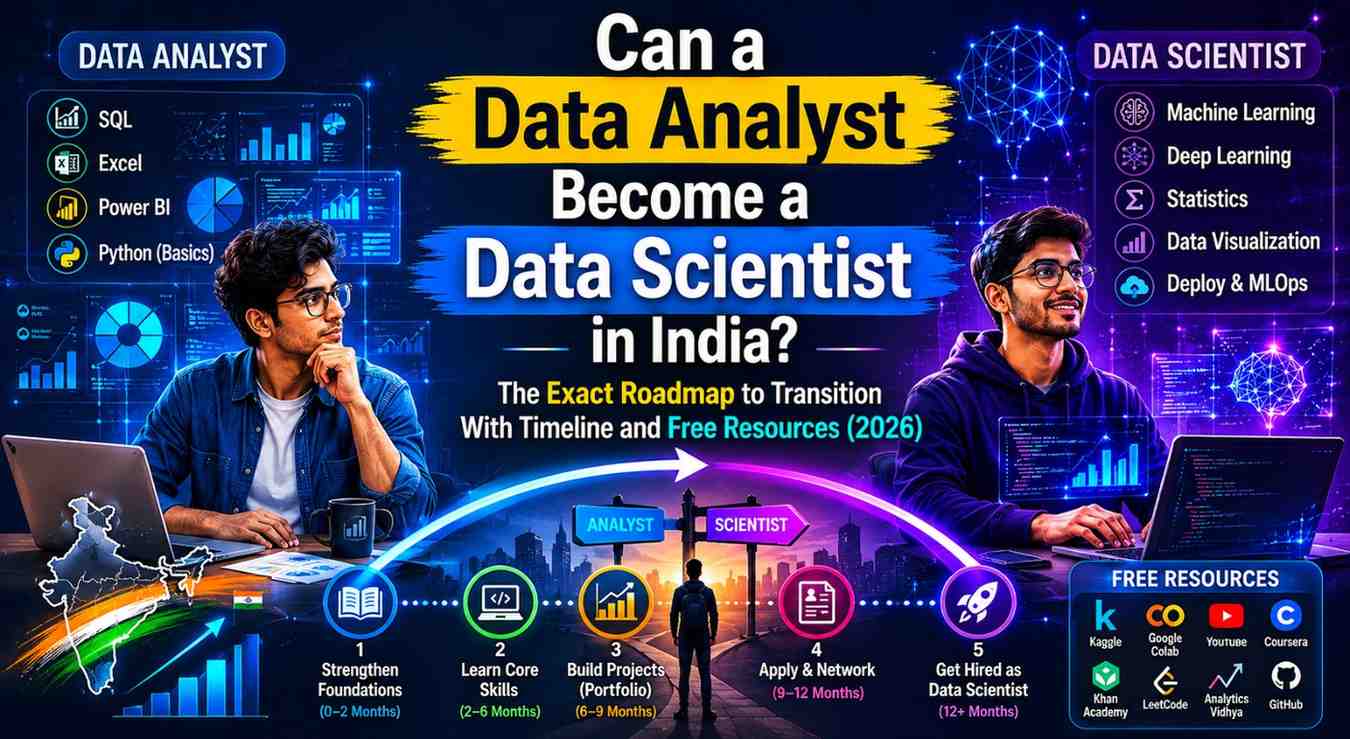
The most encouraging answer to one of India’s most searched career questions: yes—can a data analyst become a data scientist in India? Absolutely, definitively, and more commonly than you might think. Some of the most successful data scientists at top Indian companies—Swiggy, PhonePe, Razorpay, and Amazon India—started their careers as data analysts.
Can a data analyst become a data scientist in India? It is not just a yes-or-no question, though. The more valuable question is: How does a data analyst become a data scientist in India? How long does it realistically take? And what is the exact sequence of skills to build, resources to use, and steps to take—without quitting your job, without spending lakhs on expensive courses, and without taking shortcuts that leave gaps in your foundation?
This complete guide answers how a data analyst can become a data scientist in India with a 14-month roadmap, a curated free resource list, and an honest assessment of the challenges along the way.
Why Data Analysts Are Uniquely Positioned for the Transition
Can a data analyst become a data scientist in India? —And actually, you start with significant advantages:
Existing advantages data analysts carry into the transition:
- Strong SQL skills: You already write complex queries daily — SQL is the #1 prerequisite that many DS aspirants from non-data backgrounds spend months building.
- Domain expertise: You understand the business, the metrics, and the problems. Data scientists who lack this context often build technically sound models that solve the wrong problem. Your analyst experience is a genuine edge.
- Python foundation: Most data analysts have intermediate Python/Pandas skills — the foundation that ML libraries sit on top of.
- Stakeholder communication: You can present technical work to non-technical audiences—a skill many technically strong scientists struggle with.
- Data intuition: Years of exploratory analysis give you the ability to spot problems in data, understand distributions, and identify anomalies — skills that take ML practitioners from non-data backgrounds much longer to develop.
The Skill Gaps: What Data Analysts Need to Add
Can a data analyst become a data scientist in India? It requires honestly assessing the gaps:
| Skill | Analyst Level (Current) | Scientist Level (Target) | Gap Size |
|---|---|---|---|
| SQL | Expert | Expert | None |
| Python/Pandas | Intermediate | Expert (+ ML libraries) | Medium |
| Statistics | Intermediate | Advanced (probability, Bayesian) | Large |
| Machine Learning | None/Basic | Expert | Very Large |
| Deep Learning/NLP | None | Intermediate | Large |
| Experiment Design | Basic | Advanced A/B testing | Medium |
| Model Deployment | None | Basic MLOps | Medium |
| Feature Engineering | None | Advanced | Large |
The 14-Month Transition Roadmap: Can Data Analyst Become Data Scientist India
This roadmap assumes 1.5–2 hours of daily study while working as a data analyst full-time.
Phase 1 — Statistics and Probability Foundation (Months 1–3)
This is the phase most analyst-to-scientist transitions skip—and it’s why many people’s ML models work, but they can’t explain why, debug failures, or design experiments properly.
Month 1: Probability Fundamentals
- Probability basics (sample spaces, events, conditional probability, Bayes’ theorem)
- Discrete distributions (Binomial, Poisson)
- Continuous distributions (Normal, Exponential, Uniform)
- Resource: Khan Academy Statistics (free) + StatQuest YouTube
Month 2: Statistical Inference
- Hypothesis testing (t-tests, chi-square, ANOVA)
- Confidence intervals and p-values
- Type I/II errors and statistical power
- Central limit theorem—deeply understood, not just memorised
- Resource: “Statistics for Data Scientists” (O’Reilly) + Think Stats (free)
Month 3: A/B Testing and Experimental Design
- How to design an A/B experiment from scratch
- Minimum detectable effect, sample size calculation
- Multi-variate testing
- Causal inference basics
- Resource: Udacity’s A/B Testing free course, Evan Miller’s sample size calculator
Phase 2 — Machine Learning Foundations (Months 4–7)
The core of a Canadian data analyst’s transition to a data scientist in India is the machine learning foundation.
Month 4: Supervised Learning — Part 1
- Linear regression (deep understanding, not just sklearn.fit)
- Logistic regression
- Model evaluation metrics (RMSE, MAE for regression; precision/recall/AUC for classification)
- Train/validation/test splits, cross-validation
- Resource: Andrew Ng ML Specialisation Weeks 1–4 (Coursera/Audit free)
Month 5: Supervised Learning — Part 2
- Decision trees (understanding the splitting algorithm)
- Random forests (bootstrap aggregation)
- Gradient boosting (XGBoost, LightGBM)—the most used algorithms in Indian industry
- Hyperparameter tuning (grid search, random search, Optuna)
- Resource: Kaggle Learn ML (free) + XGBoost documentation
Month 6: Unsupervised Learning + Feature Engineering
- K-means clustering, DBSCAN
- PCA and dimensionality reduction
- Feature engineering techniques: encoding categoricals, handling imbalanced data, creating time features
- Pipelines in scikit-learn
- Resource: fast.ai course Part 1 (free) + “Feature Engineering for Machine Learning” book
Month 7: End-to-End ML Project
- Pick one real business problem from your analyst work domain
- Build a complete ML project: data exploration → feature engineering → model training → evaluation → documentation
- Post on GitHub with a clear README
- Resource: Kaggle (find a relevant competition) + GitHub
Phase 3 — Advanced Topics and Specialisation (Months 8–11)
Month 8–9: Natural Language Processing
- Text preprocessing (tokenisation, stemming, lemmatisation)
- TF-IDF and word embeddings (Word2Vec, GloVe)
- Text classification, sentiment analysis
- Introduction to Transformers and BERT
- Basics of LLM APIs (OpenAI, Anthropic, HuggingFace)
- Resource: Hugging Face NLP Course (free) + fast.ai NLP
Month 10: Deep Learning Basics
- Neural network fundamentals
- TensorFlow or PyTorch (pick one—PyTorch is recommended for the Indian job market 2026)
- CNNs for image data (understanding the architecture)
- RNNs and LSTMs for sequence data
- Resource: DeepLearning. AI Deep Learning Specialisation (Coursera/audit free)
Month 11: MLOps and Model Deployment
- MLflow for experiment tracking
- Flask/FastAPI for model serving
- Docker basics (containerise a model)
- AWS SageMaker basics or GCP Vertex AI
- Resource: Made With ML (free, madewithml.com) + Full Stack Deep Learning (free)
Phase 4 — Portfolio Building and Job Search (Months 12–14)
Month 12–13: Build Your DS Portfolio The answer to “Can a data analyst become a data scientist in India?” becomes “provably yes” when you have a strong portfolio:
- 3 ML projects on GitHub (end-to-end with documentation)
- 1 Kaggle competition with a medal or top-30% finish
- 1 blog post or LinkedIn article explaining a technical concept clearly
- Update your resume to highlight ML projects alongside analyst experience
Month 14: Active Job Search
- Apply to data scientist roles at companies one tier below your analyst employer initially
- Leverage your analyst domain experience — target DS roles in your current industry first
- Network with data scientists on LinkedIn — many transitions happen through referrals
- Prepare for DS interviews: ML theory questions, SQL, Python coding, case studies, and system design basics
[IMAGE 1 — Place after Phase 4]
Suggested Image: A 14-month horizontal roadmap timeline divided into 4 phases with color-coded sections—Phase 1 (Statistics, months 1–3), Phase 2 (ML Foundations, months 4–7), Phase 3 (Advanced Topics, months 8–11), and Phase 4 (Portfolio + Job Search, months 12–14)—with key milestones and free resources listed at each phase. ALT Text: “Can data analyst become data scientist India—a 14-month transition roadmap showing 4 phases from statistics foundation through ML, advanced topics, and portfolio building to job search?”
Salary Impact: Can Data Analyst Become Data Scientist India Financially
The salary uplift from a successful transition is significant:
| Role | Typical Salary (3 years’ experience) | Post-Transition DS Role |
|---|---|---|
| Data Analyst (3 yrs) | ₹12–20 LPA | — |
| Data Scientist (0–1 yr after transition) | ₹16–28 LPA | +30–50% increase |
| Data Scientist (3 yrs post-transition) | ₹25–50 LPA | +100–150% vs original analyst salary |
The financial case for a data analyst transitioning to a data scientist in India is compelling—a 3-year analyst earning ₹15 LPA can realistically reach ₹25–35 LPA within 2 years of successfully transitioning.
Common Mistakes in the Transition: Can Data Analyst Become Data Scientist India
Mistake 1: Skipping statistics Many analysts jump straight to ML algorithms without building the statistical foundation. This creates a fragile understanding—you can run models but can’t debug them or explain their behavior.
Mistake 2: Only doing courses, no projects Completing 10 Coursera courses without building projects is the most common failure mode in the “Can a data analyst become a data scientist in India?” transition. Companies hire for demonstrated capability, not course certificates.
Mistake 3: Applying for DS roles too early Applying with only 2 months of ML learning leads to failed interviews and discouragement. Complete at least Phase 1 and Phase 2 before applying.
Mistake 4: Ignoring the analyst advantage Many transitioning analysts try to compete with fresh CS graduates on pure ML theory. Your advantage is domain expertise + data intuition + business communication—play to these strengths, not away from them.
[IMAGE 2 — Place before FAQs]
Suggested Image: A “before and after” comparison card—the left side shows a data analyst profile (tools: SQL, Tableau, Excel, Pandas | salary: ₹15 LPA | title: Senior Data Analyst) → a transition arrow with “14 months + discipline” → right side shows a data scientist profile (tools: Python/ML, scikit-learn, TensorFlow, SQL | salary: ₹28 LPA | title: Data Scientist). ALT Text: “Can data analyst become data scientist India—a before and after comparison card showing data analyst profile transitioning to data scientist after 14-month roadmap with tool and salary changes?”
FAQs: Can Data Analyst Become Data Scientist India
Q1: Can a data analyst become a data scientist in India without a master’s degree? A: Yes — many successful transitions happen without additional formal education. A strong portfolio of ML projects, Kaggle participation, and demonstrated skills in interviews compensates for the absence of a master’s degree at mid-tier companies. Top-tier companies (Google, Amazon, and Microsoft India) continue to prefer master’s degrees for scientist roles, though exceptions exist.
Q2: How long does can data analyst become data scientist India realistically take? A: With consistent daily study of 1.5–2 hours: 12–14 months to be competitive for mid-tier company data scientist roles. 18–24 months to be competitive for top product companies. Rushing the timeline produces candidates who pass resume screens but fail technical interviews.
Q3: Should I tell my current employer about the can data analyst become data scientist India transition plan? A: If your current company has a data science team, express interest in cross-functional projects and internal mobility — many Indian companies facilitate internal role transitions, which are significantly easier than external job searches. If there’s no internal path, keep your plan private until you’re ready to interview.
Q4: Which free resources are best for a data analyst to become a data scientist in India transition? A: The best free resources: Andrew Ng’s ML Specialization (Coursera — audit free), fast.ai (completely free), Kaggle Learn and competitions, StatQuest YouTube channel, Hugging Face NLP Course, Made With ML, and Khan Academy Statistics.
Q5: Is it possible for a data analyst to become a data scientist in India at 30+ years of age? A: Absolutely. Many successful data science transitions happen at 28–35. Career transitions in data are skill-based, not age-based. Your professional experience and domain expertise are assets, not liabilities. Multiple LinkedIn examples exist of Indian professionals making this transition at 32–38 with excellent outcomes.
Conclusion
Can a data analyst become a data scientist in India? Yes — with the right roadmap, consistent daily learning, genuine project building, and the patience to do it properly rather than quickly. The 14-month roadmap in this guide has been validated by the career paths of hundreds of Indian professionals who made this exact transition.
The journey from data analyst to data scientist is one of the most financially and intellectually rewarding career transitions available in India’s 2026 job market. Your analyst foundation is the starting advantage that makes this transition significantly easier than starting from zero.
Start Phase 1 this weekend—open Khan Academy Statistics, commit to 90 minutes daily, and make the first move on a transition that could double your salary within 2 years.
External Links
- https://www.coursera.org/specializations/machine-learning-introduction — Andrew Ng ML Specialisation (Audit Free)
- https://www.fast.ai — fast.ai: Free Practical Deep Learning Course
- https://www.kaggle.com/competitions — Kaggle Competitions for Portfolio Building
- https://statquest.wordpress.com — StatQuest: Statistics and ML Explained Simply
- https://madewithml.com — Made With ML: Free MLOps and Applied ML Course